AI in Tennessee Security: 2026 Trends for Guards
By 2026, Artificial Intelligence will fundamentally transform physical security in Tennessee. Rather than replacing human guards, AI technologies—such as predictive threat analysis, smart surveillance, biometric access, and drone reconnaissance—will serve as powerful force multipliers. This shift will elevate security guards from passive observers to proactive, tech-enabled decision-makers, necessitating updated, tech-centric training programs across the state.
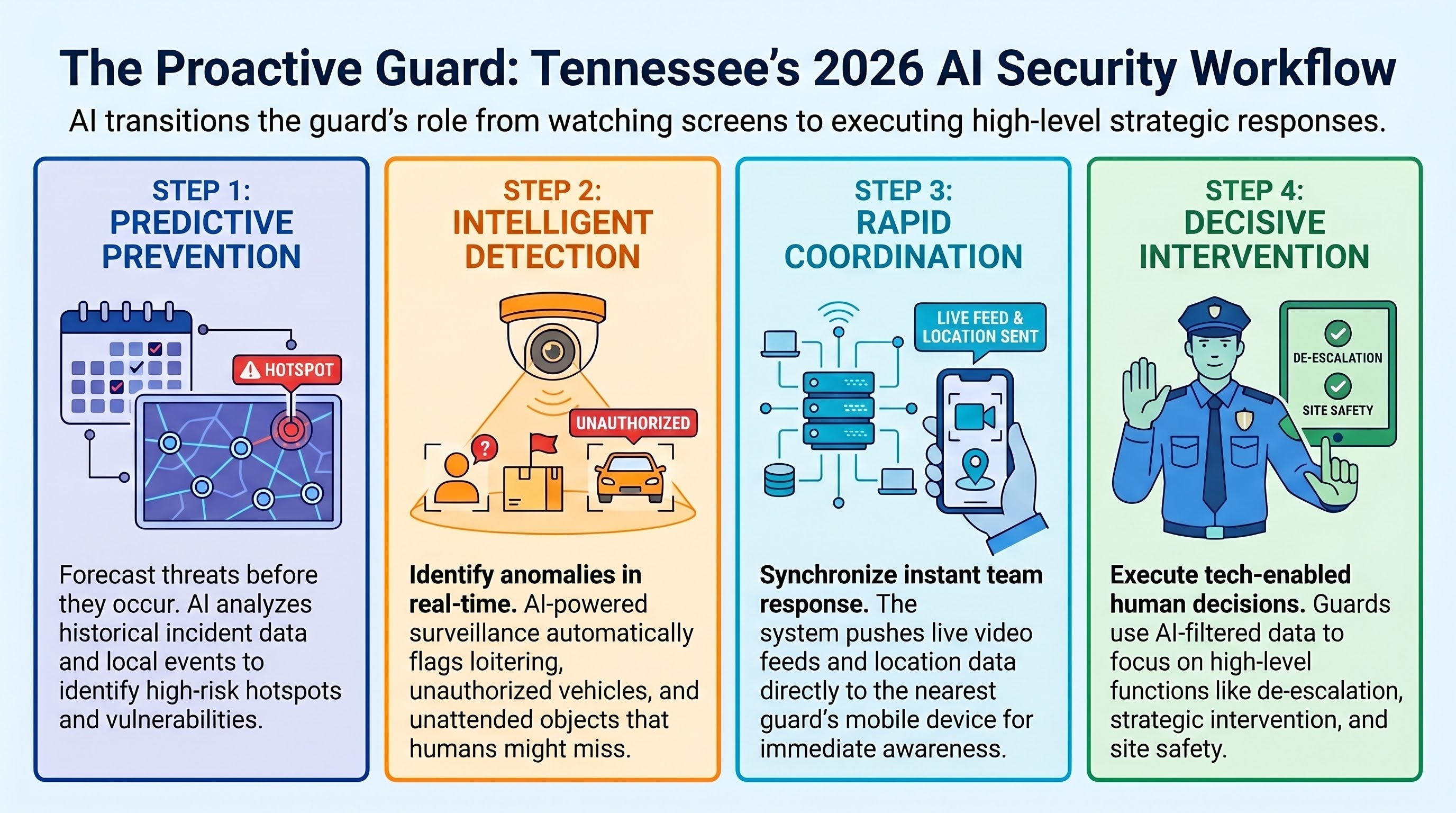
The Future of Security is Proactive
The night is quiet at a sprawling logistics hub just outside Nashville. A lone security guard monitors a bank of screens, the silence broken only by the hum of servers. Suddenly, an alert flashes. It’s not a blaring alarm from a tripped sensor, but a subtle notification from the AI system: a vehicle has been circling the perimeter for 12 minutes—a deviation from the normal pattern of late-night truck arrivals. The guard is instantly ahead of the threat, not just reacting to it.
This isn't science fiction; it is the near future of security in the Volunteer State. Traditional methods of observation and response are no longer enough to counter increasingly sophisticated threats. This post explores the transformative power of AI in Tennessee security, detailing the specific 2026 tech trends that will empower guards, streamline operations, and create a safer environment for businesses and communities from Memphis to Knoxville.
The Shifting Security Landscape in the Volunteer State
Tennessee is a hub of economic growth, home to thriving industries in logistics, healthcare, manufacturing, and technology. With this growth comes an increased need for sophisticated security solutions. High-value assets, critical infrastructure, and bustling public spaces require more than just a watchful eye; they demand proactive, intelligent protection.
The challenge for security firms across Tennessee is to scale their effectiveness without increasing manpower exponentially. This is where artificial intelligence steps in, offering a powerful force multiplier that enhances human capabilities.
What is AI in Security? Beyond the Sci-Fi Hype
When we talk about AI in security, we're not talking about autonomous robots patrolling hallways. Instead, think of AI as a brilliant partner that can process vast amounts of data in milliseconds. It excels at:
- Pattern Recognition: Identifying unusual activities that a human might miss.
- Predictive Analysis: Using historical data to forecast potential security risks.
- Data Correlation: Connecting seemingly unrelated events to uncover a potential threat.
For a security guard, AI acts as a second set of eyes and an analytical brain, filtering out the noise and highlighting what truly matters.
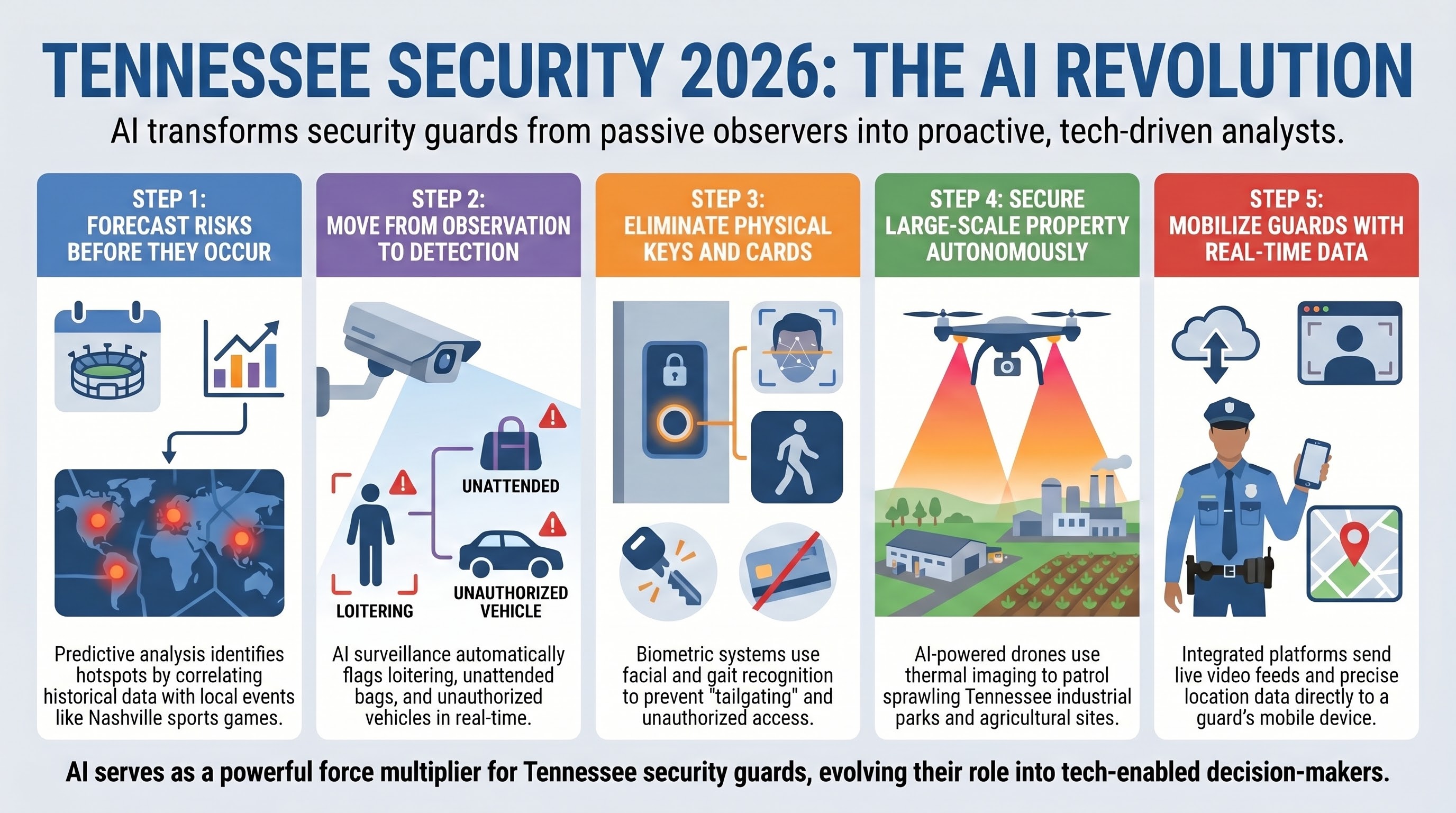
Top 5 AI Tech Trends Revolutionizing Tennessee Security by 2026
The future of physical securityis being written today. By 2026, these five AI-driven trends will become standard practice for forward-thinking security teams in Tennessee.
1. Predictive Threat Analysis
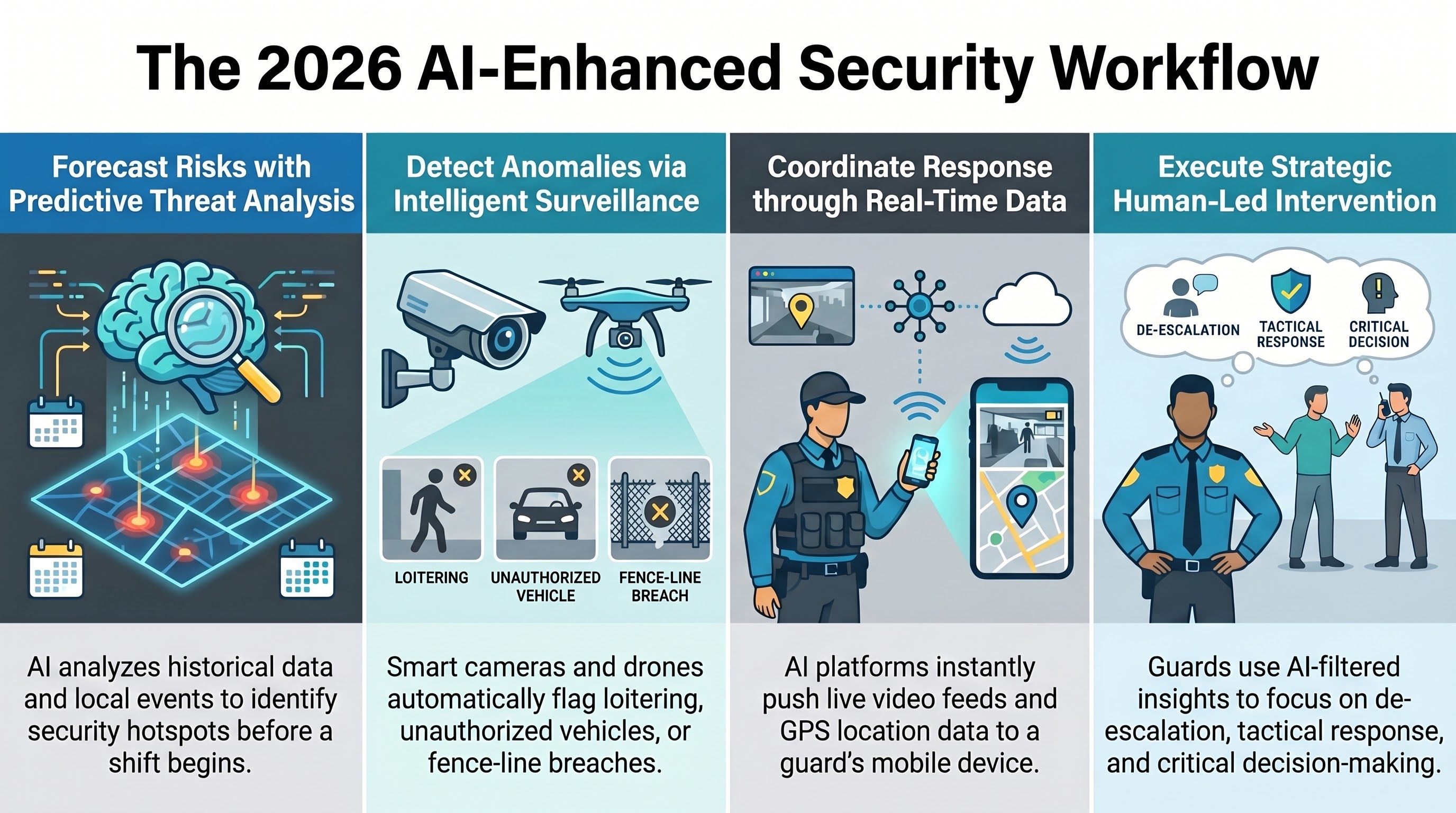
Imagine knowing where a security breach is most likely to occur before it happens. Predictive analysis makes this possible. AI systems can analyze diverse data sets to identify potential hotspots and vulnerabilities by looking at:
- Historical Incident Data: Analyzing past break-ins, thefts, or disturbances.
- Environmental Factors: Correlating security risks with weather patterns, local events (like a Titans game in Nashville),or traffic congestion.
- Social Media Monitoring: Scanning public social media for chatter that might indicate a planned protest or threat near a protected site.
A guard in Chattanooga overseeing a manufacturing plant can receive an alert that a specific gate is at high risk on a Friday night, based on historical data and a nearby public event, allowing them to adjust their patrol route accordingly.
2. AI-Powered Surveillance and Anomaly Detection
The days of staring at grainy CCTV footage for hours are numbered. AI surveillance systems are transforming passive cameras into active, intelligent sentinels. These systems can be trained to recognize and flag specific behaviors in real-time, including:
- Anomaly Detection: Identifying a person loitering in a restricted area after hours or a vehicle parked in a fire lane.
- Object Recognition: Differentiating between a stray animal and a human, or detecting an unattended bag in a high-traffic Memphis lobby.
- License Plate Recognition (LPR): Automatically logging and cross-referencing vehicle plates against a database of authorized or flagged vehicles.
3. Real-Time Communication and Response Coordination
During a security incident, clear and rapid communication is critical. AI-driven platforms act as a central nervous system for a security team. When a threat is detected, the system can:
- Instantly send alerts to the nearest guard's mobile device with a live video feed and location data.
- Automatically notify the central command center.
- Log the incident and generate a preliminary report.
- Provide a direct line to local law enforcement with all relevant data in critical situations.
4. Biometric Access Control and Identity Verification
Keys and keycards can be lost, stolen, or duplicated. AI-enhanced biometrics provide a far more secure method of access control. Systems using facial recognition, fingerprint scanning, or gait analysis ensure that only authorized personnel enter sensitive areas. The AI component can also detect "tailgating" and flag attempts to spoof facial recognition scanners.
5. AI-Enhanced Drones for Patrol and Reconnaissance
For sprawling properties like university campuses, industrial parks, or agricultural operations in rural Tennessee, AI-powered drones offer a powerful solution. Drones can autonomously patrol pre-defined routes using thermal and high-definition cameras. The onboard AI analyzes feeds in real time, identifying heat signatures in dark fields or fence-line breaches and immediately alerting on-ground security.
The Role of the Guard in an AI-Powered World
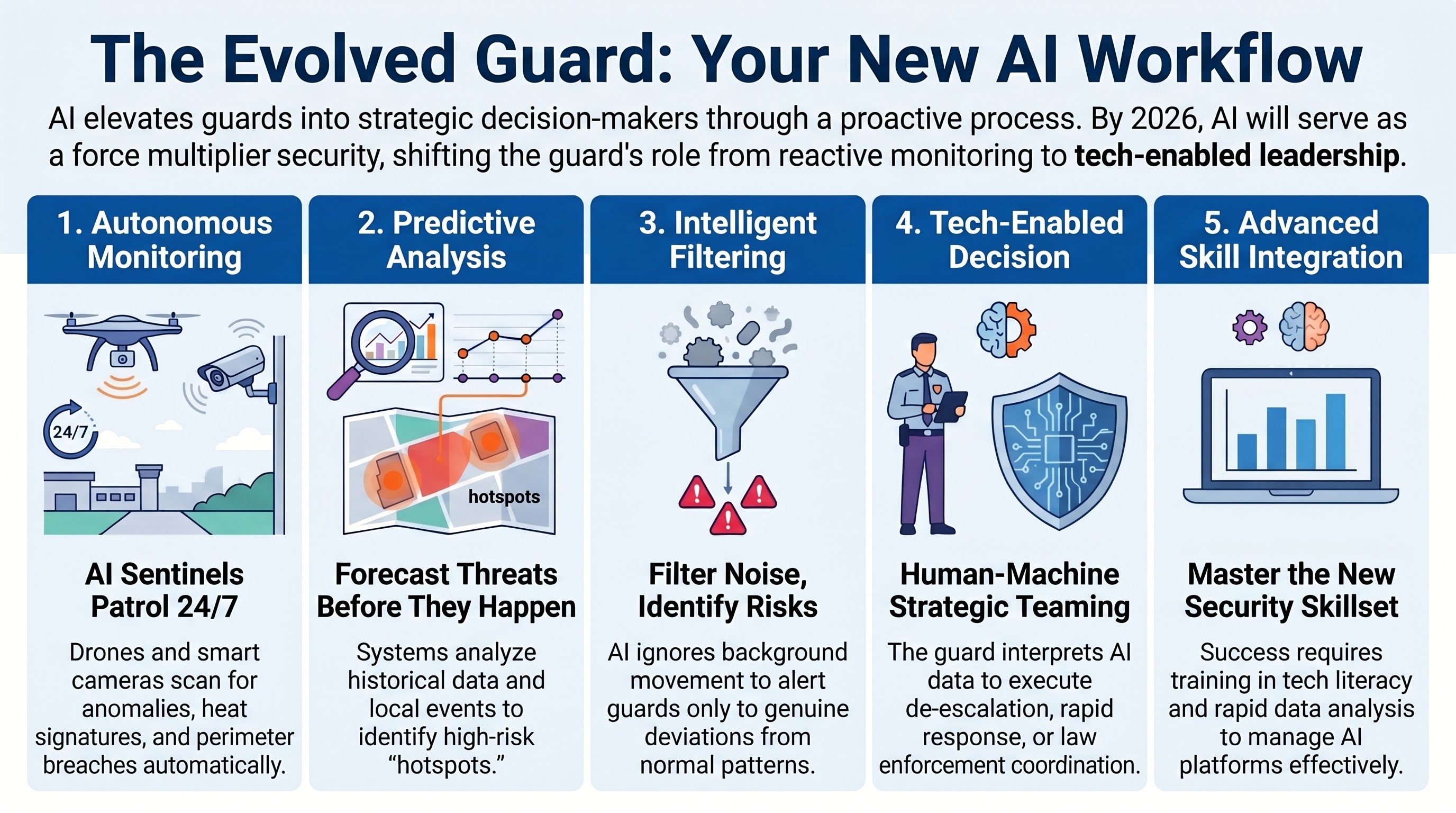
A common fear is that AI will make security guards obsolete. The reality is the exact opposite. AI elevates the guard, shifting their role from a passive observer to a proactive, tech-enabled analyst.
From Observer to Decision-Maker
With AI handling monotonous observation, guards are freed up to focus on higher-level functions: strategic decision-making, rapid response, de-escalation, and customer service. They become the human element that interprets AI data and executes the appropriate action.
The Importance of New Skills: Tennessee Security Guard Training
To thrive in this new environment, Tennessee security guard training must evolve to include:
- Tech Literacy: Operating and interpreting data from AI security platforms.
- Data Analysis: Quickly assessing AI-provided information to determine threat severity.
- Human-Machine Teaming: Working collaboratively with AI systems as a partner.
Conclusion: A Smarter, Safer Tennessee
The integration of AI in Tennessee security is an imminent reality. By 2026, predictive analysis, intelligent surveillance, and automated response coordination will be the cornerstones of effective protection. These tools will amplify a guard's senses, streamline workflows, and empower them to be more proactive than ever before. Embracing the future of physical security means embracing AI—resulting in a smarter, more responsive, and safer Tennessee.
Call to Action
Is your Tennessee security team prepared for the AI revolution? Don't let your protection strategy fall behind. Contact us today for a consultation to train your staff.
https://sleek.bio/guardtrainingtn
Frequently Asked Questions (FAQ)
1. Will AI replace security guards in Tennessee?
No, AI is designed to augment, not replace, security guards. It handles data-intensive monitoring tasks, allowing human guards to focus on critical thinking, intervention, and on-site decision-making.
2. What is the first step to integrating AI into our existing security plan?
The best first step is a security audit. Assess your current vulnerabilities and identify which AI technologies provide the greatest ROI. Upgrading to AI surveillance systems is often a logical starting point because they integrate with existing camera infrastructure.
3. How can AI improve security in rural Tennessee areas with less infrastructure?
AI-powered drones can patrol large agricultural or industrial properties far more efficiently than foot patrols. Additionally, smart camera systems with satellite or 4G connectivity can monitor remote access points and alert guards or owners via mobile devices.
4. Are AI surveillance systems that use facial recognition legal in Tennessee?
As of now, the use of facial recognition technology by private entities in Tennessee is largely unregulated, but laws are constantly evolving. It is crucial to work with a knowledgeable security provider and legal counsel to ensure deployments comply with privacy laws and ethical guidelines.

Article by Angel Rodriguez CPP
Published 27 Apr 2026