Dallas Law Tennessee 2026: Compliance Guide for Security Guards and Venue Operators
Quick Answer: Dallas Law Compliance in Tennessee
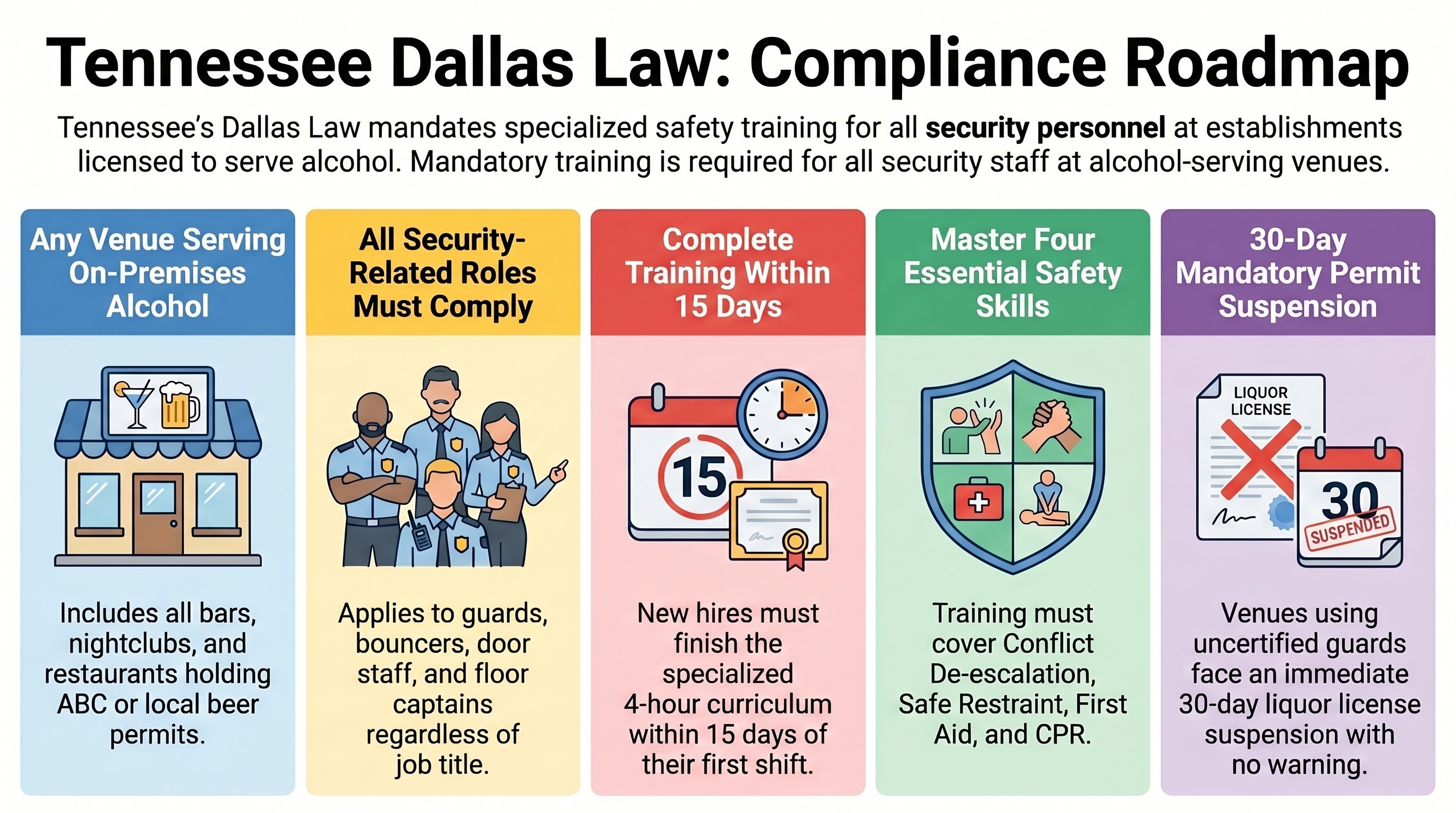
Who Must Comply: All armed and unarmed guards performing observation, detection, or rules enforcement at establishments licensed for on-premises alcohol consumption (ABC or beer permits).
Deadline: Guards must complete the specialized 4-hour Dallas Law training within 15 days of starting work at a licensed venue.
Required Training: The curriculum must cover Conflict De-escalation, Safe Restraint, First Aid, and CPR.
Penalty for Venues: Venues found using uncertified guards face a mandatory 30-day suspension of their liquor license or beer permit.
Renewal: Dallas Law certification is valid for 2 years and must be renewed as part of the guard’s standard security registration.
What Is Dallas Law in Tennessee?
Dallas Law (codified under T.C.A. § 62-35) was enacted following the 2021 death of Dallas “DJ” Barrett during a security incident at a Nashville bar. Governor Bill Lee signed the legislation in 2022, and it took full effect on January 1, 2023.
The law eliminated the previous “bouncer exemption,” requiring anyone performing security functions at alcohol-serving establishments to meet formal training and background check standards. It applies to bars, nightclubs, and restaurants with alcohol permits, as well as to both contract security companies and in-house security teams.
Who Must Comply with Dallas Law?
Dallas Law applies to:
Any establishment with an ABC or local beer permit for on-premises alcohol consumption.
Proprietary Security Organizations (in-house security/bouncers).
Contract security companies providing guards to hospitality venues.
Any individual performing observation, detection, or enforcement of rules — regardless of job title (e.g., door staff, floor captains, or hosts).
Note: While focused on hospitality venues, Dallas Law exists alongside other specialized requirements, such as active-shooter training under HB 322 for guards in educational settings.
The Four Core Training Requirements
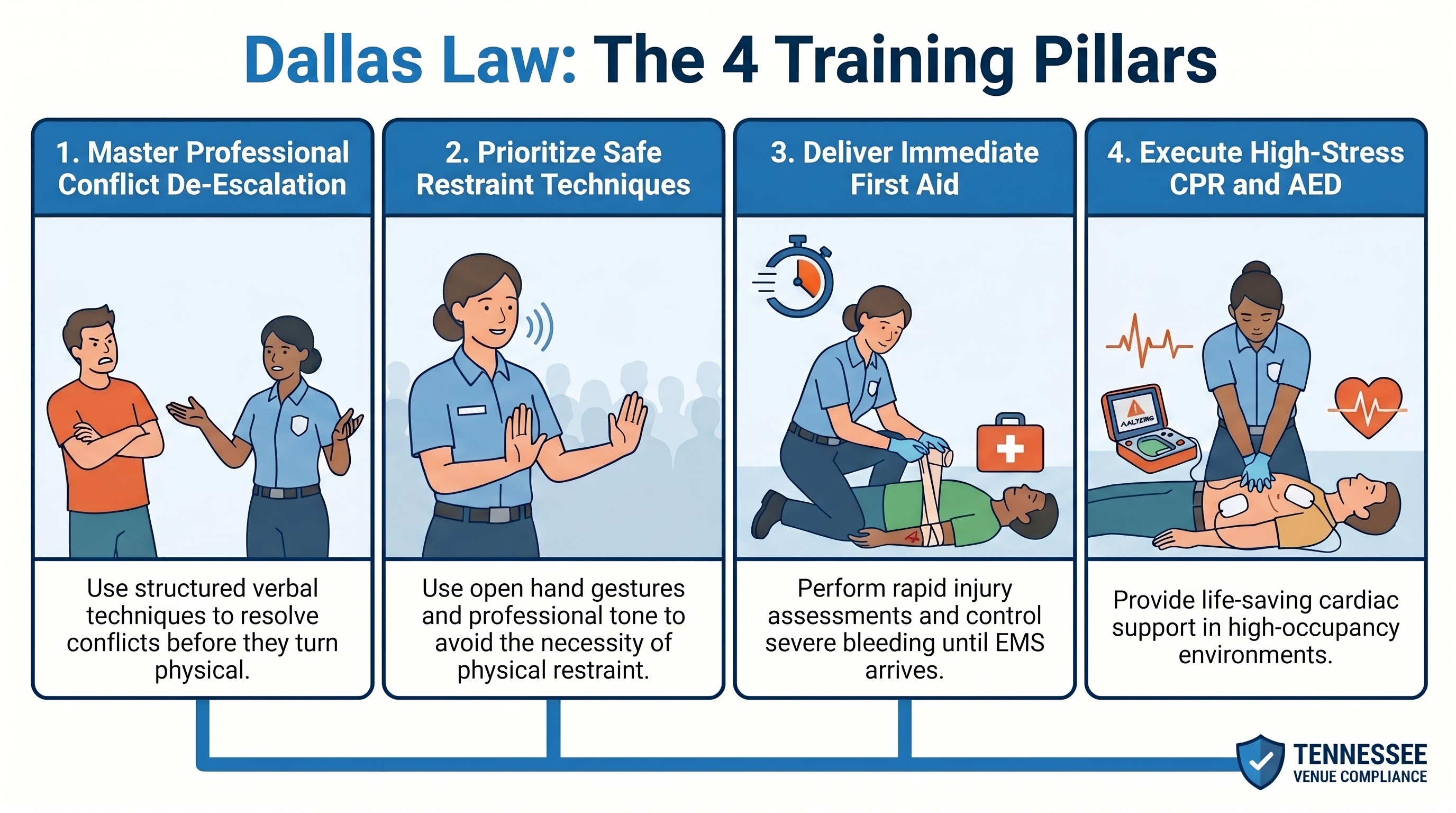
Dallas Law requires a 4-hour specialized curriculum delivered by a state-approved provider, in addition to standard unarmed or armed licensing.
Conflict De-Escalation
Reduces reliance on physical force and lowers civil liability. The training teaches guards to recognize early warning signs of escalation and apply structured verbal techniques to resolve conflicts professionally.
Safe Restraint
Focuses on preventing injury and positional asphyxia. Guards learn the legal standards for physical intervention, how to recognize signs of distress, and when restraint is (or is not) justified.
First Aid
Prepares guards to act as immediate responders. Training covers rapid injury assessment and critical interventions, such as controlling severe bleeding, until EMS arrives.
CPR
Builds the ability to respond to cardiac emergencies in high-occupancy environments. Guards learn effective CPR techniques and AED use under stress until professional help takes over.
Compliance Timeline and Consequences
The burden of compliance rests on the employer. Key rules include:
15-Day Rule: Guards must complete Dallas Law training within 15 days of their first shift at a licensed venue.
30-Day Suspension Risk: Venues that use uncertified guards face a mandatory 30-day suspension of their liquor or beer permit, with no warning period.
90-Day Grace Period: While a 90-day window exists for standard license renewals, guards cannot work with an expired registration. Licenses that have expired for more than 90 days are purged from the state system.
Legal Integration with TCA § 62-35-118
Dallas Law is a specialized classification attached to a standard Tennessee Armed or Unarmed registration — it is not a standalone permit.
Unarmed guards working for Proprietary Security Organizations (PSOs) are prohibited from carrying weapons or less-lethal devices, including batons, chemical sprays, and tasers. Violations can result in immediate license revocation.
Reducing Liability Through Professional Response Skills
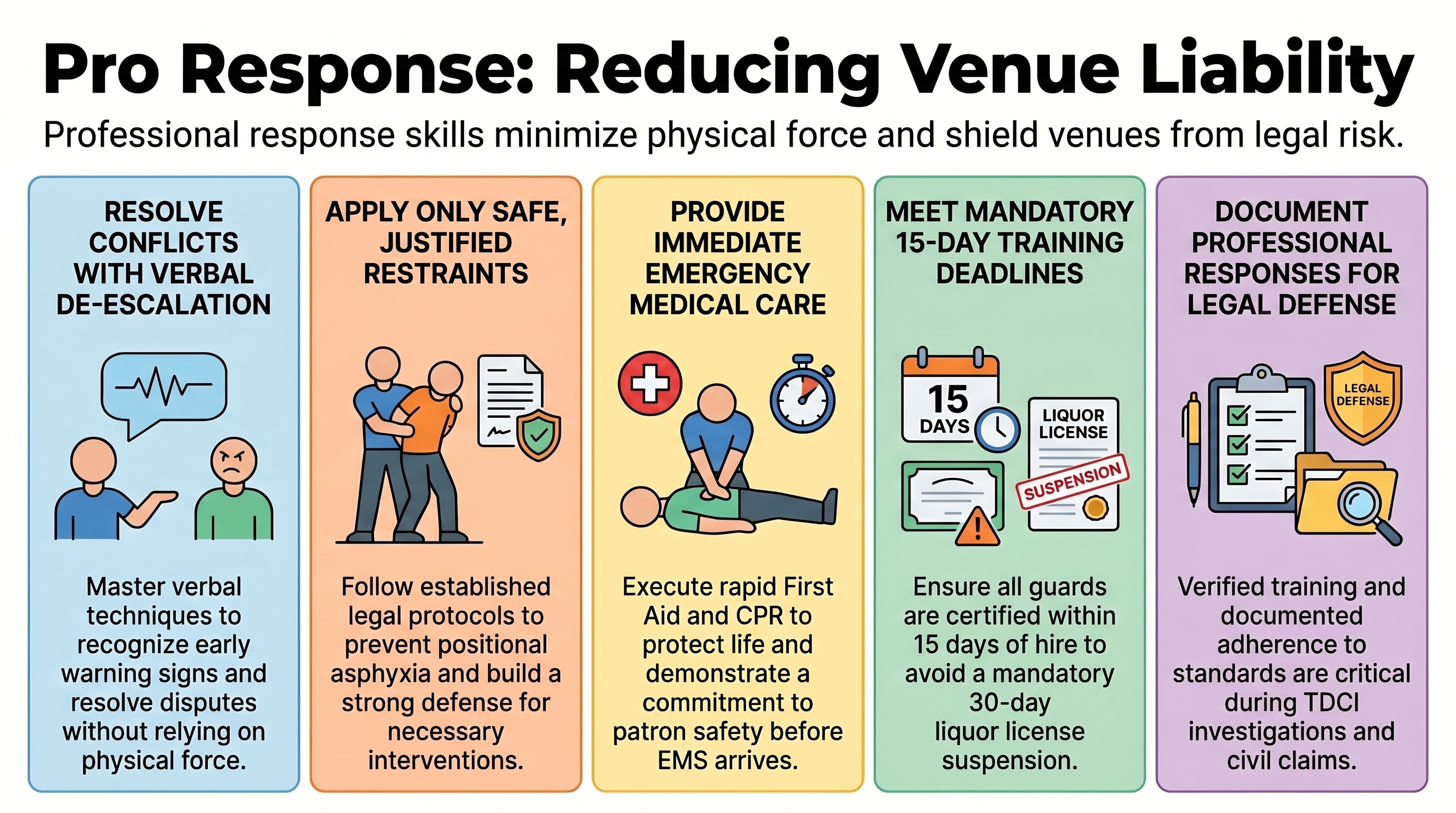
Proper training in de-escalation and safe restraint reduces risk for both guards and venues. Guards trained in these skills are better equipped to resolve conflicts before situations escalate to physical force.
When force is necessary, following established protocols and using only reasonable restraint creates a stronger legal defense. Documentation showing that a guard acted within accepted standards is a critical factor during TDCI investigations and civil claims.
Venues that employ properly trained staff demonstrate a clear commitment to safety and regulatory compliance.
Best Practices and Common Pitfalls
Common Pitfalls to Avoid:
Attempting to skip or fast-forward through online training modules results in removal from the course.
Failing to disclose prior arrests on applications, even if believed to be expunged.
Missing the 15-day training window due to poor onboarding processes.
Recommended Best Practices:
Maintain printed proof of CORE application submission while on duty.
Use the “Bouncer Bundle” for new hires, which efficiently combines the foundational unarmed course and Dallas Law training.
Why Train with Alliance Training & Testing?
Alliance Training & Testing is Tennessee’s leading provider for Dallas Law compliance because our instructors authored the official state-approved Dallas Law training curriculum.
Owner Angel Rodriguez, CPP, served as a primary author of the Dallas Law Classification Curriculum and currently serves on the State of Tennessee Private Protective Services Committee. We were the first provider to offer this course in a fully online, mobile-responsive format.
Frequently Asked Questions
How long is the Dallas Law course?
The course takes approximately 5 to 5.5 hours and is available on demand 24/7.
What happens if my standard license has expired for more than 90 days?
Your license is purged from the state system. You must reapply as a new applicant and complete the foundational training again.
Can I work while my application is pending?
Yes, for up to 75 business days with printed proof of your CORE submission (does not apply to armed guards).
What is the passing score?
You must score at least 70% on the final exam. Three attempts are allowed.
How long do I have to complete the online course after purchase?
You have 30 days from the date of purchase to finish the training.

Article by Angel Rodriguez CPP
Published 11 Jun 2026