📱 Security Under Scrutiny How Smartphone Cameras Impact Guard Liabilities In TN
Introduction
Five years ago, most security interactions in Tennessee happened with a reasonable expectation that the details would stay between the people involved. Today, that assumption no longer holds.
The moment someone pulls out a smartphone, an ordinary conversation or confrontation can be preserved indefinitely, reviewed in slow motion, shared widely, and used as evidence in legal or administrative proceedings. This single change has quietly altered private security work in ways that many training programs and daily habits have not yet fully addressed.
In Tennessee, this shift intersects with Dallas Law requirements, use-of-force expectations, and licensing standards. The presence of a recording device does not simply document events — it changes behavior, decision-making, and how incidents are later judged.
This article examines the practical effects of constant public recording on security professionals working in Tennessee.
How Does Public Smartphone Recording Cause a Psychological and Behavioral Shift in Security Work?
When a phone appears during an interaction, the dynamic often changes immediately.
Guard Reactions: Some guards become more deliberate. They may slow their movements, speak more clearly, or begin narrating their actions. Others feel the pressure and either rush decisions or become noticeably more rigid and defensive.
Subject Reactions: On the other side, the person being addressed may become more combative or theatrical because they know they are being recorded.
These behavioral shifts are now a consistent feature of security work rather than rare exceptions. The mental load of knowing that actions may be reviewed later — often without full context — adds pressure that did not exist in the same way a decade ago.
This psychological effect influences everything from how quickly a guard intervenes to how they communicate during de-escalation attempts. It also affects how subjects respond, sometimes escalating a situation because both sides are now performing, at least in part, for an unseen audience.
Why Does De-Escalation on Camera Differ from De-Escalation in Reality?
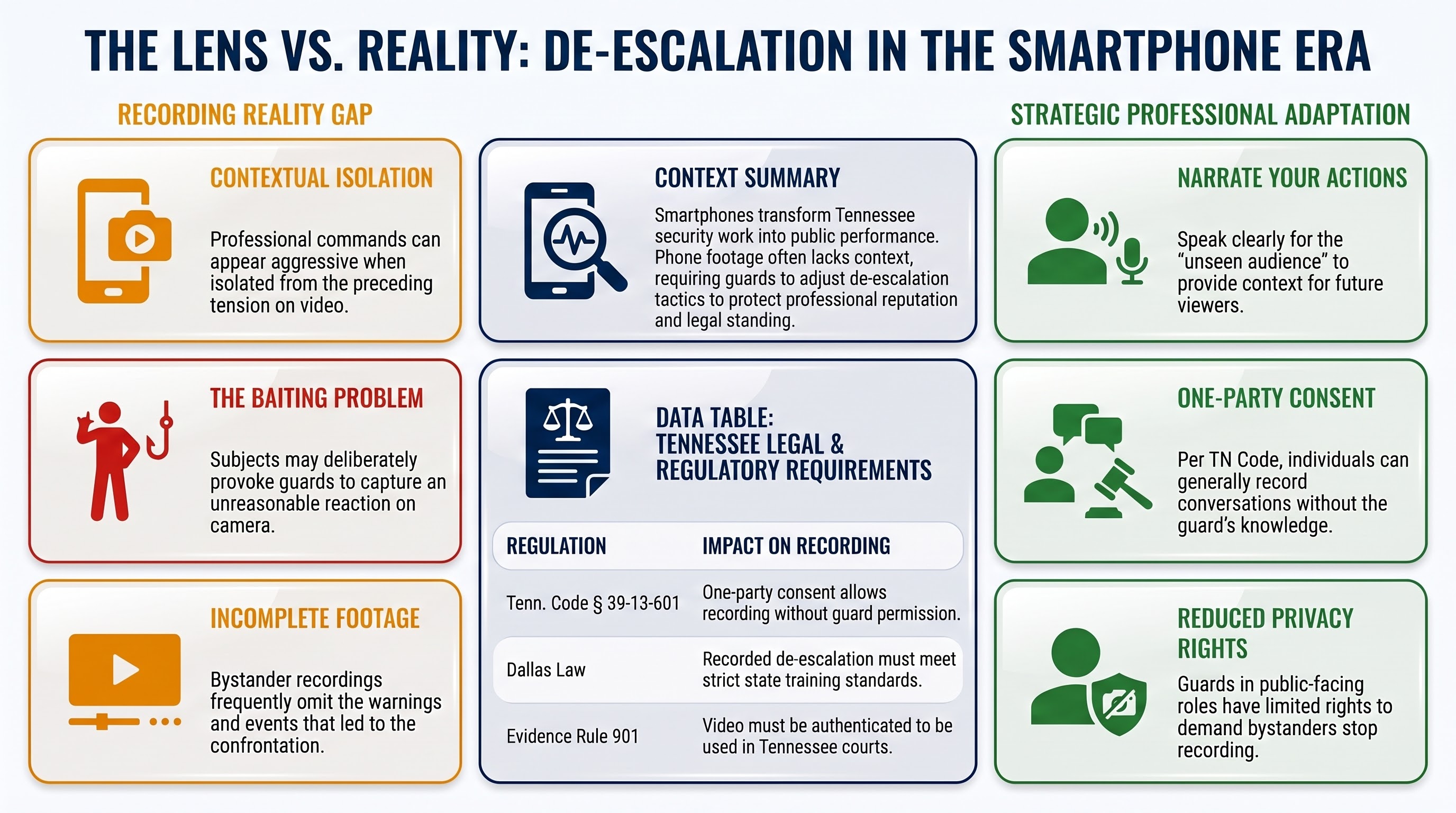
De-escalation techniques that worked well in person can lose effectiveness when every word and movement may be recorded and replayed.
Contextual Isolation: Verbal commands that once sounded calm and professional can appear different when isolated on video without the surrounding context. A statement that felt measured in the moment can later be portrayed as aggressive, depending on the camera angle or on what happened in the seconds before the recording started.
Incomplete Footage: Phone footage frequently captures only part of an interaction. Viewers often see neither what led up to the recording nor what occurred after it stopped. This missing context poses a risk to both guards and the people they interact with.
The Baiting Problem: There is also the growing problem of being baited. Some individuals deliberately provoke reactions because they know they are being filmed. A guard who remains professional for several minutes can still appear unreasonable if only the final exchange is shown.
These realities require security professionals to adapt how they communicate and position themselves the moment a phone appears.
What Is the Legal Reality of Public Recording and Video Evidence in Tennessee?
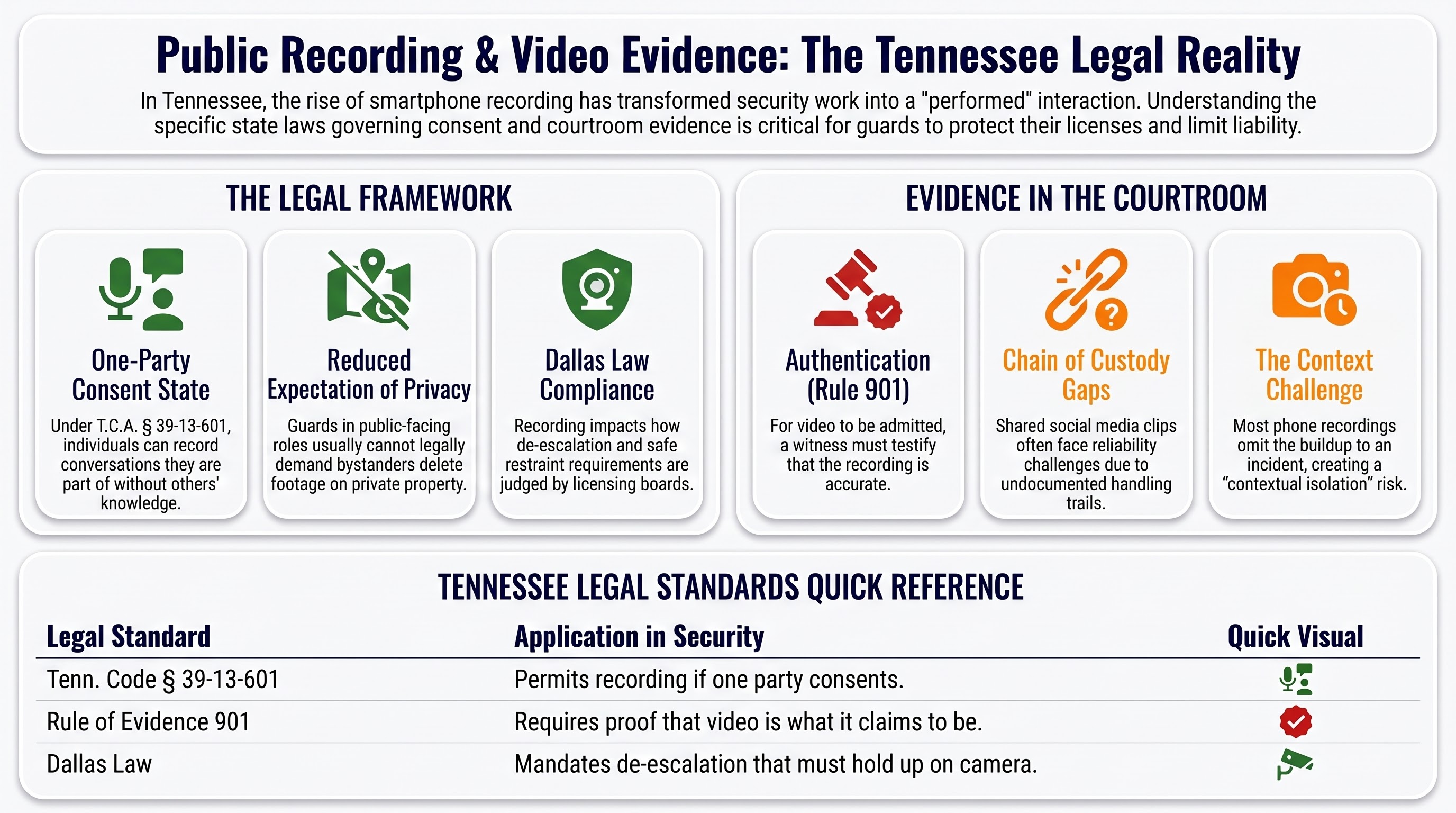
Tennessee is a one-party consent state. Under Tenn. Code Ann. §§ 39-13-601 and 39-13-604, a person who is part of a conversation can generally record it without the other party’s knowledge, provided it is not done with criminal or tortious intent.
More relevant for security work is how phone footage is used afterward. Video recorded on smartphones is frequently offered as evidence in civil lawsuits, criminal cases, insurance claims, and proceedings involving security licenses or registrations.
Relevance and Authentication: For a video to be admitted in Tennessee courts, it must generally satisfy the requirements of relevance and authentication under Tennessee Rule of Evidence 901. The party offering the video must present enough evidence for the court to find that the recording “is what its proponent claims.” This is commonly done through testimony from the person who recorded it or from a witness who observed the events.
Chain of Custody: It also matters with digital evidence. It refers to the documented trail showing who handled the file and how it was preserved from the time it was recorded until it is presented in court. The goal is to show that the video has not been altered. With bystander phone footage, establishing a perfect chain of custody is often difficult because the recording was not collected by law enforcement or trained security personnel. Videos are frequently shared via text, social media, or cloud links, which can create gaps. Tennessee courts do not always require an unbroken chain, but significant weaknesses can be used to challenge the video’s reliability or reduce the weight it is given.
Private Property Considerations: Most security work occurs on private property that is open to the public (bars, stores, event venues, apartment complexes, etc.). While property owners have the right to set recording policies and ask people to stop or leave, individual security guards generally have limited personal privacy rights in these spaces. Courts have consistently held that people performing public-facing duties in publicly accessible areas have a reduced expectation of privacy. This means guards usually cannot successfully demand that bystanders delete footage of them after the fact, except in narrow situations involving commercial misuse of their image.
What Evidence and Liability Challenges Are Created by Phone Footage?
Phone footage has become one of the most powerful — and unpredictable — forms of evidence in security-related incidents.
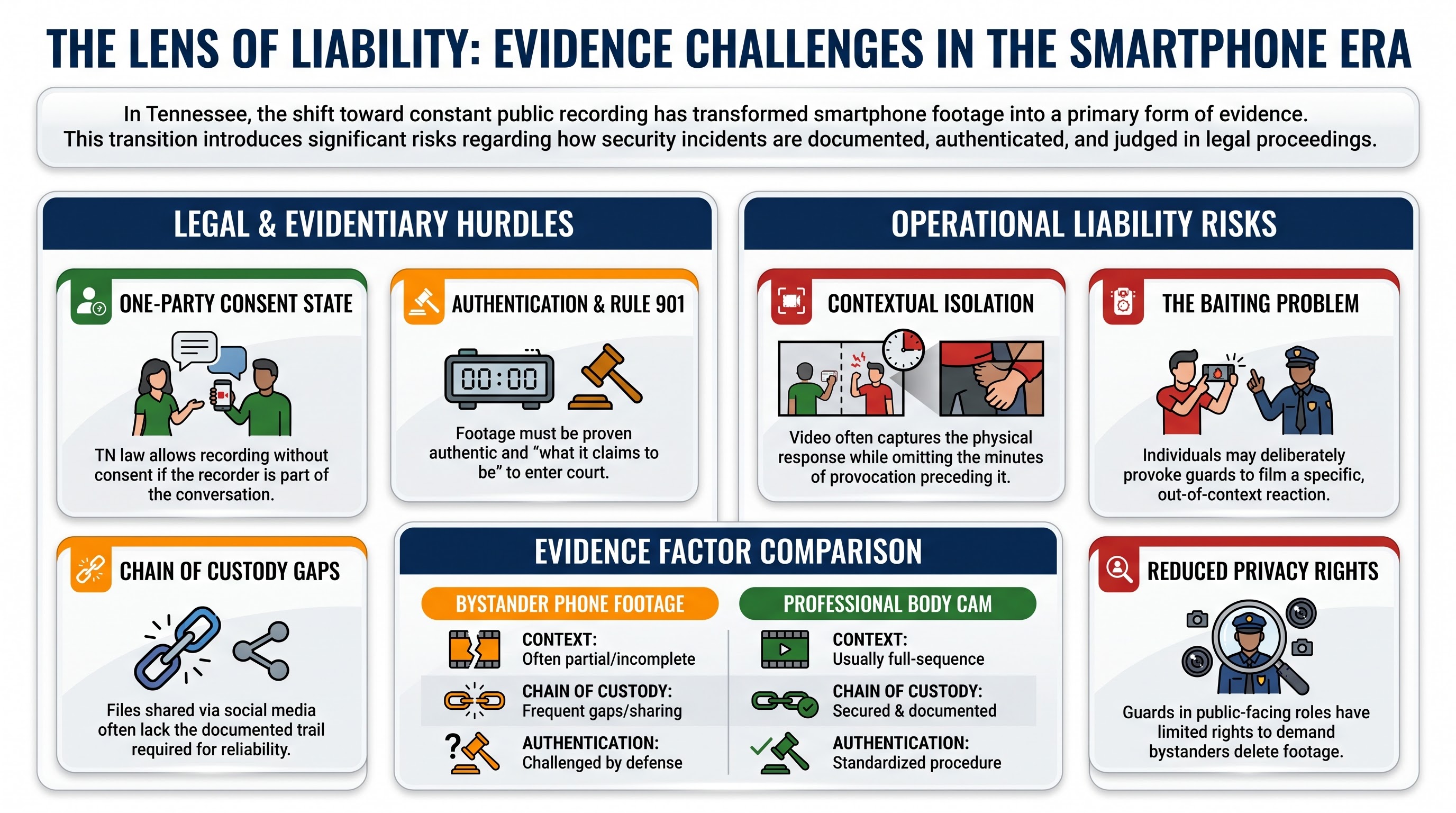
The Challenge of Context: A video that shows only the final moments of a confrontation can make a measured response appear excessive. Because most phone recordings begin after tension has already escalated, they often omit the buildup that explains a guard’s decisions.
Chain of Custody Gaps: When footage is shared via text, messaging apps, or social media, questions about whether it was edited or altered become common points of attack. Even when admitted, gaps in the chain can significantly reduce the weight the video carries with judges, juries, or licensing boards.
Increased Liability Exposure: Clear video can protect a guard who acted appropriately. However, the same footage — or a selectively edited version — can support claims of excessive force, failure to follow Dallas Law requirements, or other violations. Venues and contract companies face both legal and reputational risk when incidents are recorded and later shared or used in proceedings.
Selective Recording: A person may start recording only after they believe they have been wronged, creating an incomplete record that is difficult to fully rebut.
Security professionals must now operate with the understanding that nearly every significant interaction carries the potential to become evidence that may be incomplete or challenged on technical grounds.
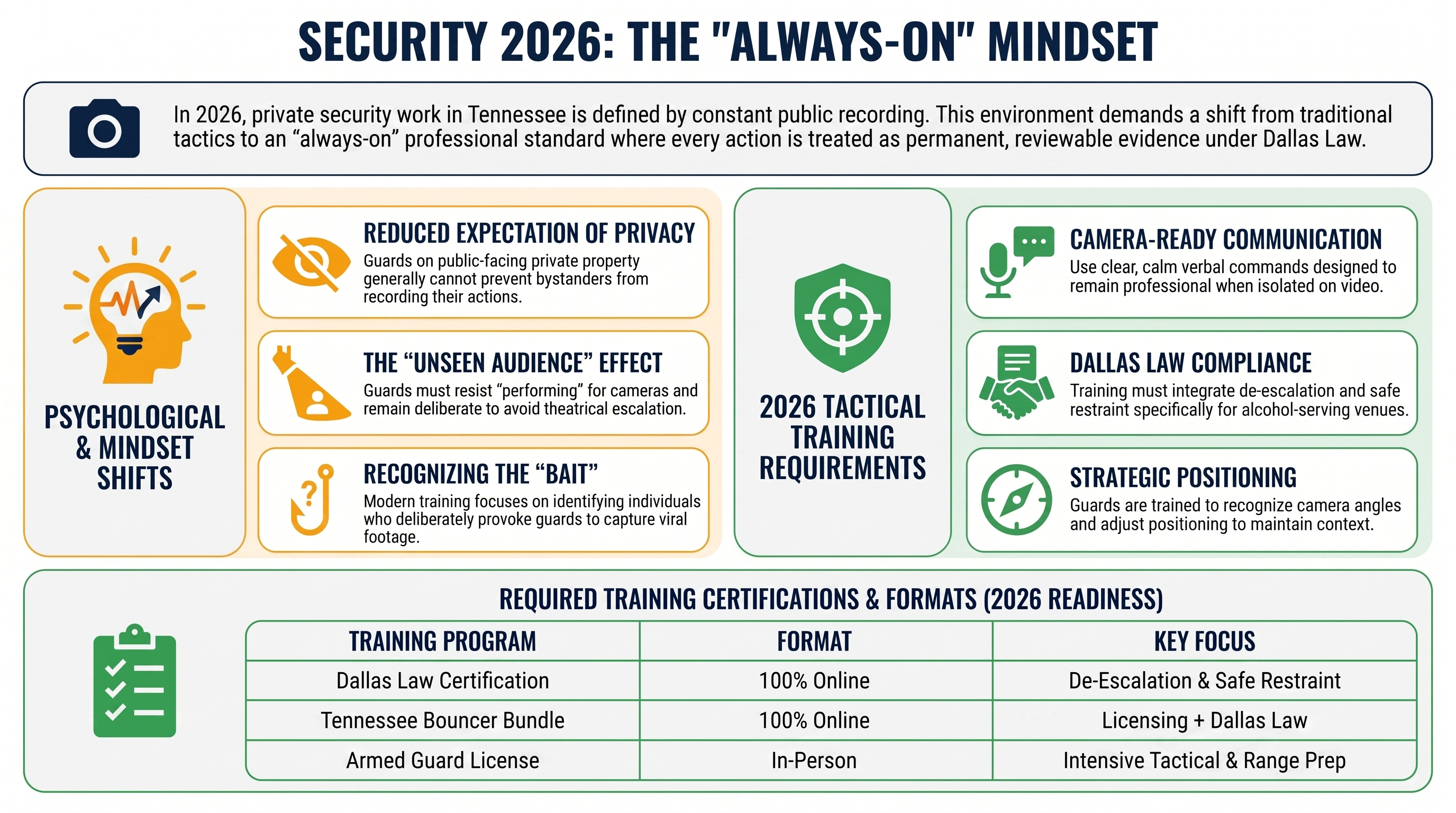
What Security Training and Mindset Adjustments Are Required in 2026?
Traditional security training often assumed that most interactions would not be recorded or later dissected in detail. That assumption is no longer valid.
Guards now benefit from practical skills that account for recording devices. This includes:
Clearer verbal communication that holds up on video.
Better awareness of camera angles and positioning when phones appear.
The ability to recognize when recording has begun and adjust the approach accordingly.
Decision-making frameworks must also evolve. Guards benefit from thinking not only about the person in front of them, but also about how their actions will appear if reviewed later by investigators, attorneys, or the public. This does not require becoming overly hesitant or theatrical. It requires maintaining professional standards under the added pressure of being recorded.
These adjustments directly align with existing Dallas Law de-escalation and response requirements.
Real Tennessee Scenarios: Operational Impact in the Field
Dallas Law Situations: Consider a typical Dallas Law situation in a bar or nightclub. When a phone comes out during a removal or altercation, the guard must balance immediate safety concerns with how their words and actions will appear on video that may later be reviewed by management, law enforcement, or in a civil claim.
Trespass or Removal Situations: In a trespass or removal situation on private property, a bystander recording from a distance may capture only part of the interaction. The resulting video can support claims that force was unnecessary while omitting earlier warnings or the subject’s prior behavior.
Retail or Property Confrontations: In such confrontations, phone footage is increasingly common. The guard who maintains calm, clear communication and proper positioning is better protected when that footage is later reviewed — even if the video itself has gaps in context or chain of custody.
These scenarios show why awareness of recording has become a core operational consideration.
What Needs to Change for Security Companies Going Forward?
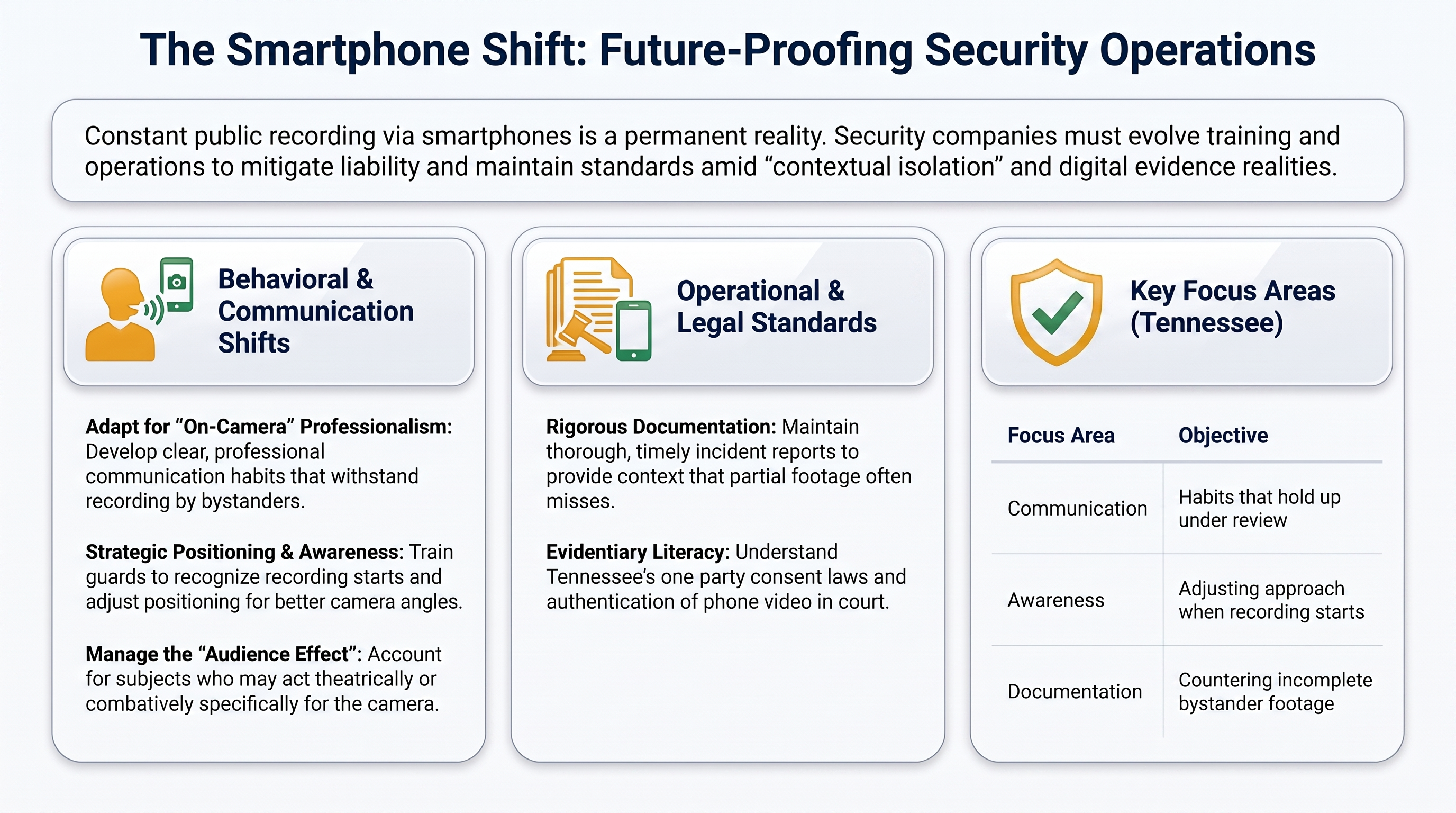
Security professionals and companies that want to operate effectively should focus on several practical areas:
Developing communication habits that remain clear and professional even when being recorded
Improving awareness of when recording begins and adjusting positioning and verbal approach accordingly.
Maintaining thorough, timely documentation of incidents, including any known recording.
Understanding the basic evidentiary realities of how phone video is authenticated and challenged in Tennessee proceedings.
Implementing Objective Counter-Evidence Coverage: Reliable CCTV coverage in key areas can help mitigate some of the challenges posed by incomplete or selective smartphone recordings. In one notable Nashville incident at Roberts Western World, bystander phone footage captured only part of a confrontation, but the venue’s own security cameras provided additional context that proved valuable during the investigation. Companies that maintain clear, well-positioned CCTV systems are better equipped to reconstruct events accurately when phone footage is limited, edited, or taken out of context. This can help reduce liability exposure and support fairer resolutions in disputes or legal proceedings.
These changes are about maintaining professional standards in an environment where nearly every interaction can be preserved and reviewed.
Conclusion
Constant public recording via smartphones is now a permanent feature of private security work in Tennessee. The professionals and companies that adapt their communication, decision-making, and documentation to this reality will handle incidents more effectively and carry lower risk. Those who continue operating under older assumptions will face increasing exposure when incidents are recorded and later scrutinized.
The goal is not to eliminate recording — that is no longer possible. The goal is to perform the job with the same professionalism, whether or not a phone is pointed at you.

Article by Angel Rodriguez CPP
Published 25 Jun 2026