Why Alliance Training & Testing Will Not Offer the Tennessee Enhanced Armed Guard Rifle Certification
By Angel Rodriguez, CPP
The private security landscape in Tennessee underwent a significant change in 2026 with the implementation of the new Enhanced Armed Guard certification, established under SB 1384 / HB 683. This legislation permits highly vetted private security personnel to carry and deploy long guns—specifically rifle-caliber weapons—under tightly controlled conditions.
Since the law took effect, Alliance Training & Testing has received numerous inquiries from armed guards asking when we will begin offering the 16-hour rifle certification course.
Our answer is clear and final: We will not.
As a Certified Protection Professional (CPP) with decades of experience in the security industry, I base every business decision on practical reality, rigorous risk assessment, and long-term liability management. Offering this certification would contradict those principles. Here is why the ballistic realities, operational restrictions, and structural limitations make it an untenablechoice for a responsible training academy.
1. The Catastrophic Liability of Over-Penetration in Real-World Environments
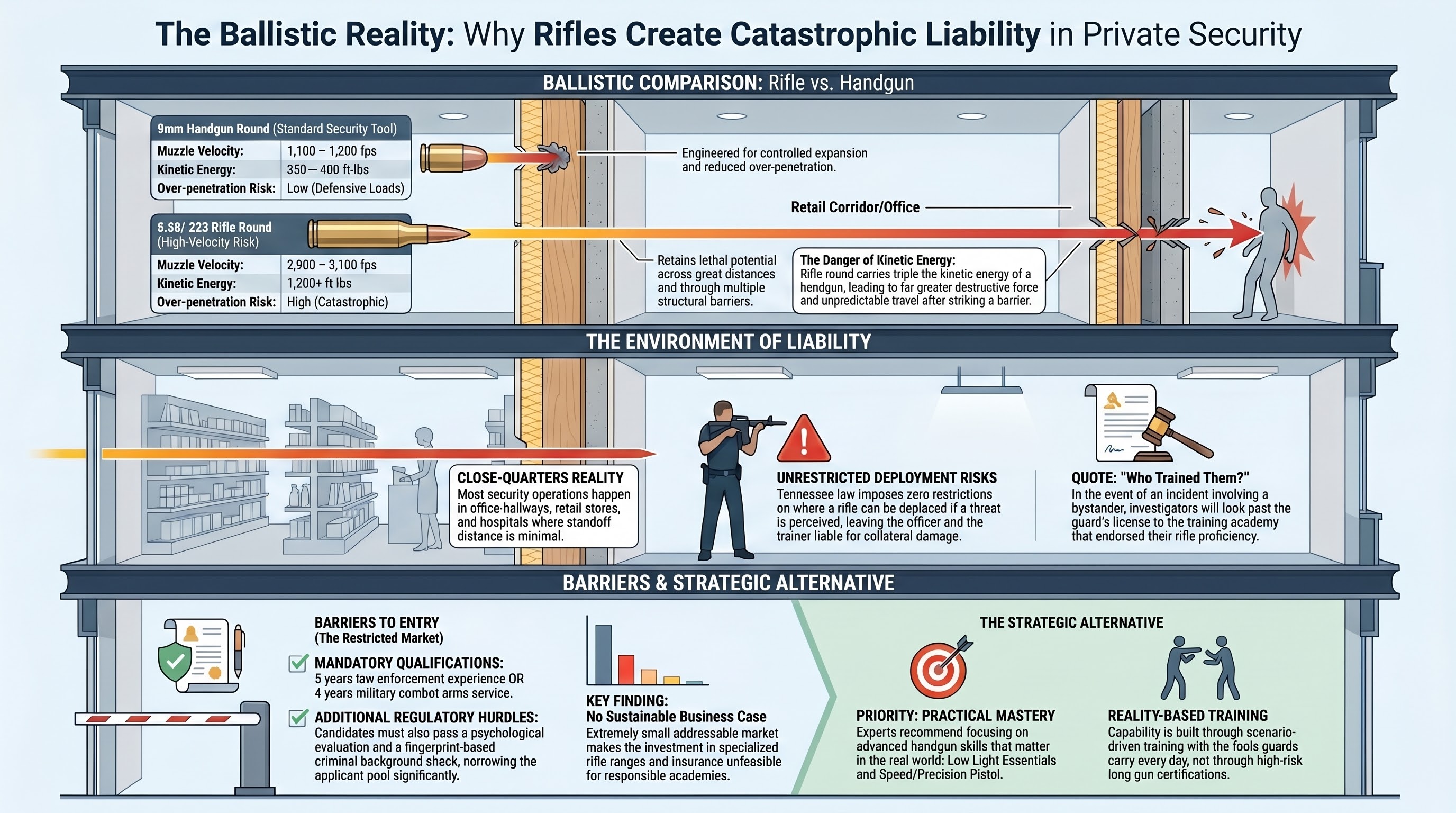
Security officers work in close quarters—office hallways, retail aisles, schools, hospitals, and corporate campuses. These environments offer little standoff distance, yet the new legislation imposes zero restrictions on rifle deployment in such spaces when a perceived threat exists.
Rifle-caliber ammunition introduces ballistic risks that standard handgun training cannot mitigate. Consider the fundamental differences:
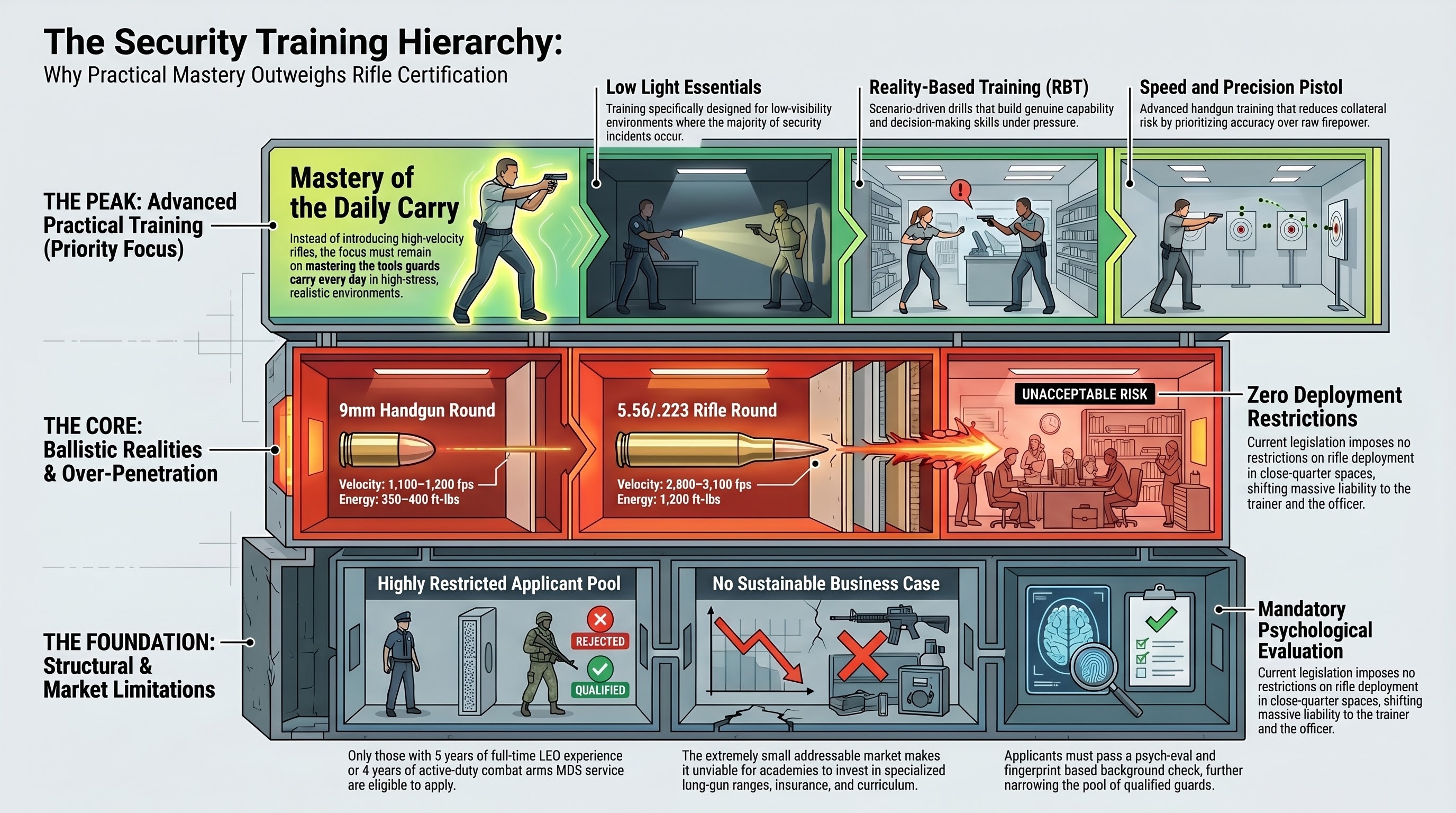
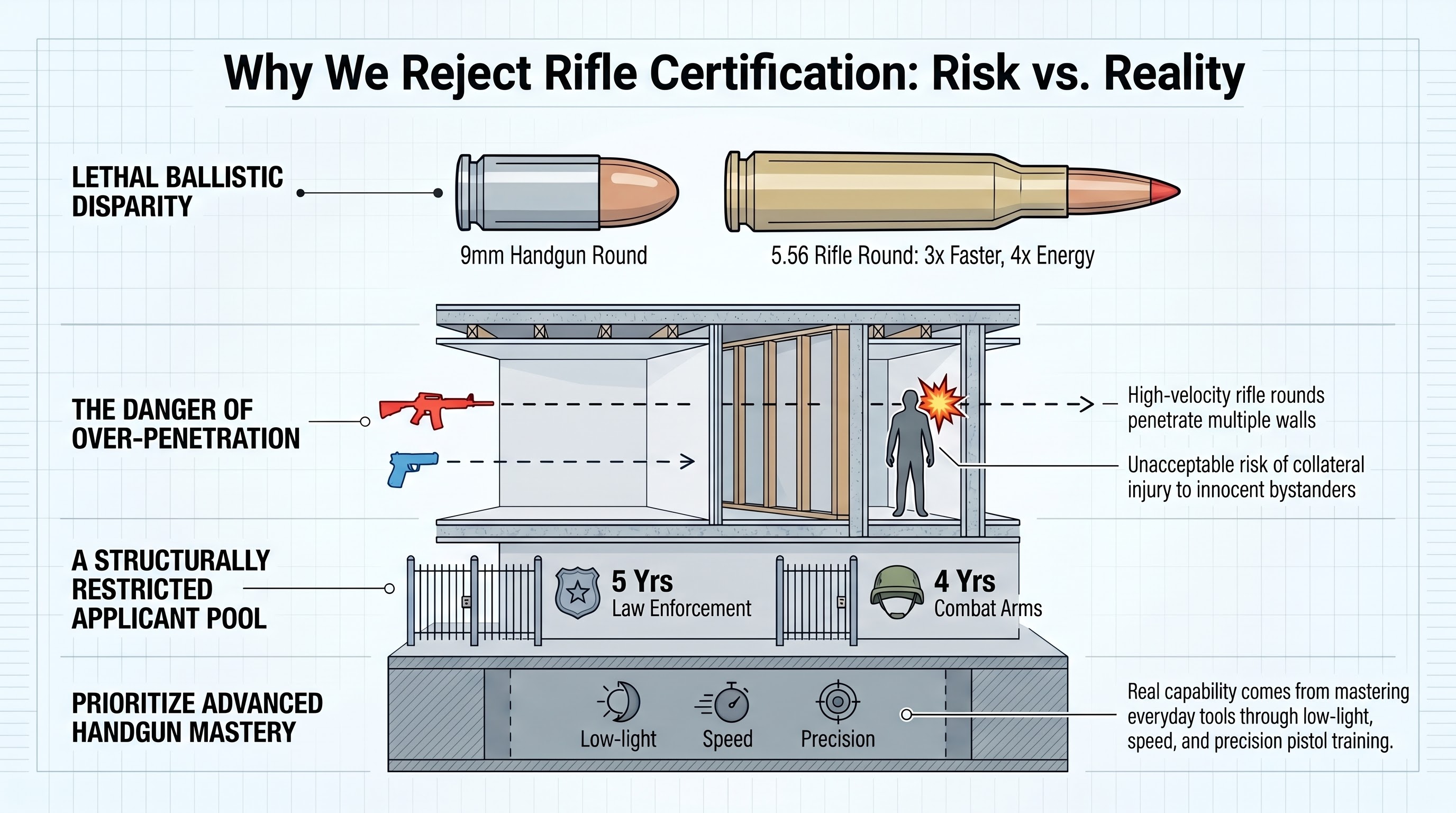
5.56/.223 Rifle Round: Muzzle velocity of 2,900–3,100 feet per second with over 1,200 foot-pounds of energy.
9mm Handgun Round: Muzzle velocity of 1,100–1,200 feet per second with only 350–400 foot-pounds of energy.
This vast disparity in velocity and kinetic energy allows rifle rounds to retain lethal potential across much greater distances and penetrate multiple layers of drywall, wood framing, and common building materials with far greater destructive force. While many defensive handgun loads are engineered for controlled expansion and reduced over-penetration, high-velocity rifle projectiles frequently continue traveling after striking a threat or barriers—creating unacceptable risk of collateral injury in dynamic, real-world scenarios.
In any post-incident investigation, the first questions will be:
1: “Was the security officer licensed and certified to carry the rifle?”
2: If certification is confirmed, the inquiry immediately shifts to:
3: “Who trained them?”
Tennessee’s rifle training standards remain loosely defined. I cannot in good conscience attach my name—or the reputation of Alliance Training & Testing—to a program lacking comprehensive, peer-reviewed standards developed by expert trainers. The ballistics alone demand far more rigorous preparation than currently required.
2. A Structurally Restricted Applicant Pool (Zero Sustainable Business Case)
Responsible training academies succeed by delivering high-volume, high-quality programs that serve the full spectrum of Tennessee security professionals—unarmed-to-armed upgrades, renewals, and standard handgun certification.
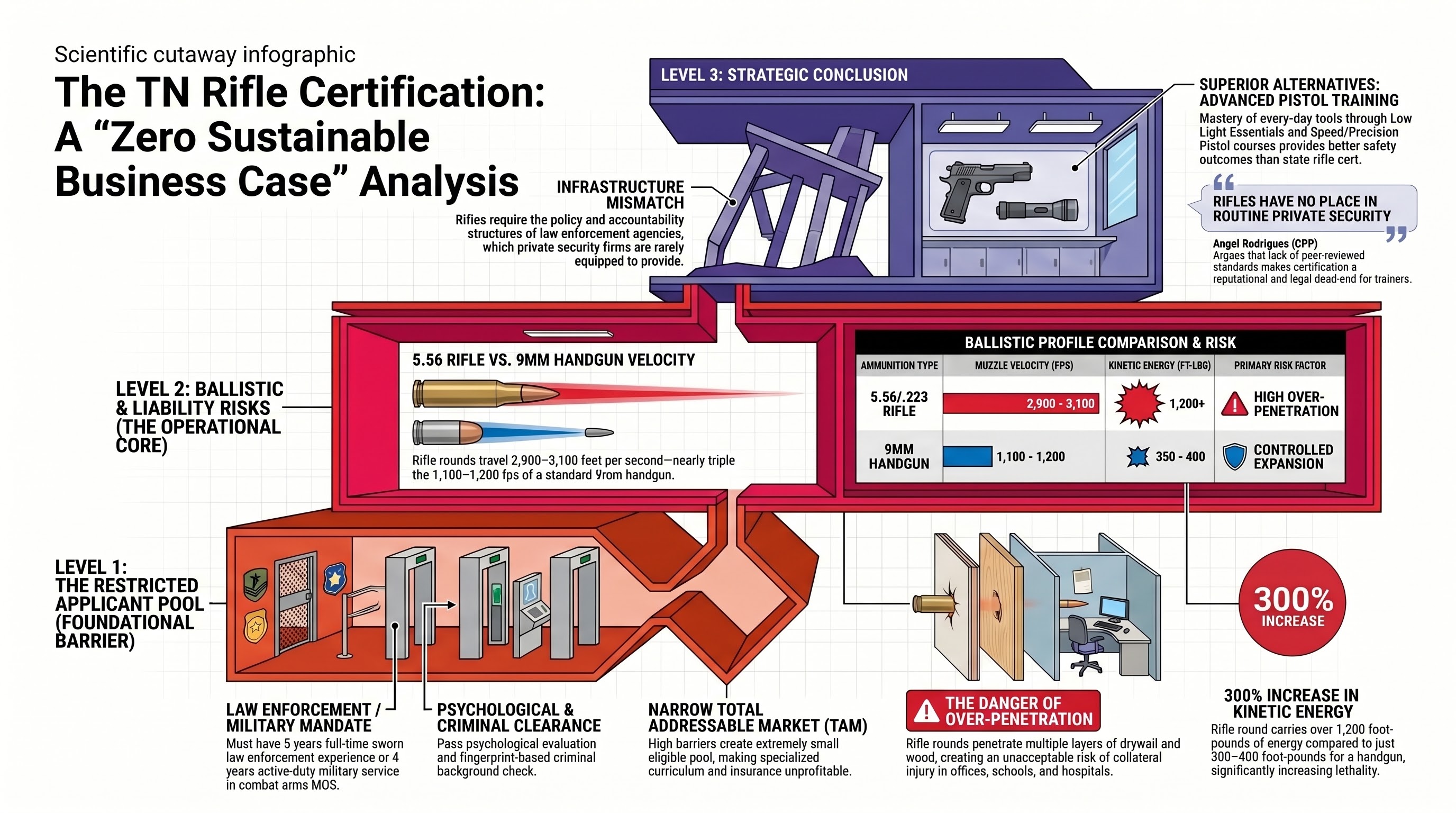
The state has intentionally limited eligibility for the Enhanced Armed Guard certification to a narrow group. Applicants must:
Possess 5 years of full-time sworn law enforcement experience, or
Have 4 years of active-duty military service in a combat arms MOS,
PLUS - pass a psychological evaluation and fingerprint-based criminal background check.
This creates an extremely small Total Addressable Market. The vast majority of working armed guards and new entrants simply do not qualify. Developing a specialized rifle curriculum, securing dedicated long-gun range facilities, obtaining additional insurance, and qualifying instructors for such a limited audience offers no viable return on investment.
3. What Expert Trainers Would Have Advised
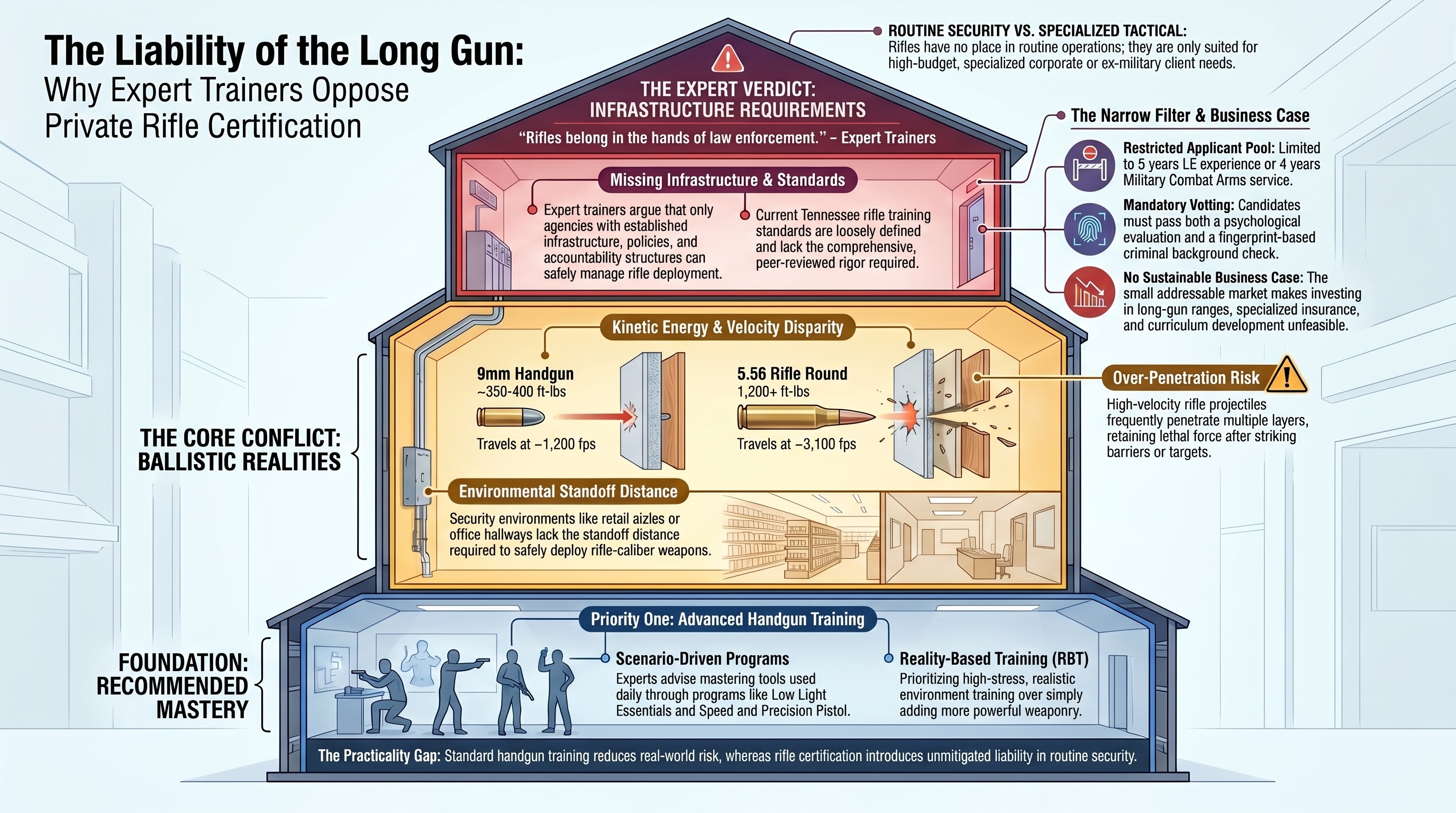
If lawmakers had consulted experienced trainers before advancing this legislation, the clear recommendation would have been: rifles belong in the hands of law enforcement agencies equipped with the infrastructure, policies, and accountability structures necessary for their safe deployment. Most states across the country have reached the same conclusion.
“My sincere hope is that Tennessee will revisit this law before an incident involving an innocent bystander forces a reactive repeal. Rifles have no place in routine private security operations.” Angel Rodriguez CPP
4. What the Law Should Have Prioritized: Advanced Practical Training That Matters
If the goal was truly to elevate security capabilities, the focus should have remained on mastering the tools guards actually carry every day—their handguns—in high-stress, realistic environments.
That is precisely why Alliance Training & Testing partners with Royal Range. We prioritize advanced, scenario-driven training that directly reduces risk and improves performance: Low Light Essentials, Speed and Precision Pistol, and Reality-Based Training.
These programs build genuine capability. A state-issued rifle certification does not.
The Bottom Line
Alliance Training & Testing is making a deliberate, safety-first decision rooted in liability management and industry realities. We will continue to deliver the highest-quality, high-volume handgun training that serves the broader Tennessee security market effectively and responsibly.
The enhanced rifle certification may appeal to a handful of specialized providers serving ex-military or high-budget corporate clients. For the standard Tennessee security professional, however, the ballistic risks, loosely defined standards, and real-world liabilities make it impractical—and a program I will never endorse.
Ready to Train Smarter?
If you are a security professional seeking practical, risk-conscious training that truly enhances your capabilities, enroll in our standard Armed Guard certification, advanced handgun courses, or state-mandated Dallas’s Law training at Alliance Training & Testing.
Contact us today to secure your spot. Visit our website to get started.

Article by Angel Rodriguez CPP
Published 10 May 2026