2026 Tennessee Bouncer License Requirements: 5 Legal Realities of Dallas Law
2026 Tennessee Bouncer License Requirements: 5 Legal Realities of Dallas Law
Quick Answer for 2026 Tennessee Security Requirements: To work as a security professional or bouncer in a Tennessee establishment that serves alcohol, you must comply with the Dallas Law (Tenn. Code Ann. § 62-35-118). This requires formal registration, mandatory de-escalation and first-aid training within 15 days of hire, and a 4-hour refresher course every two years. Furthermore, as of 2026, new legislative updates have introduced stricter disqualifying offenses and complex grace-period rules for new hires.
More Than Just a Clipboard and a Stare
There is a persistent and dangerous misconception that working security at a Tennessee nightlife venue is purely a matter of physical presence—being "big" enough to stand at a door, check IDs, and offer an intimidating stare. In the modern regulatory environment, "muscle" is an outdated asset. Today, the role has evolved into a highly regulated professional position.
The landscape of Tennessee security changed fundamentally with the implementation of the Dallas Law, which shifted the focus from simple gatekeeping to comprehensive public safety. In 2026, navigating these requirements is no longer optional; state audits are stricter than ever. For those entering the field, the Tennessee Bouncer Bundle from Alliance Training and Testing remains the gold standard for meeting these rigorous requirements through an accessible, digital-first platform.
1. Alcohol and Security are Legally Tethered
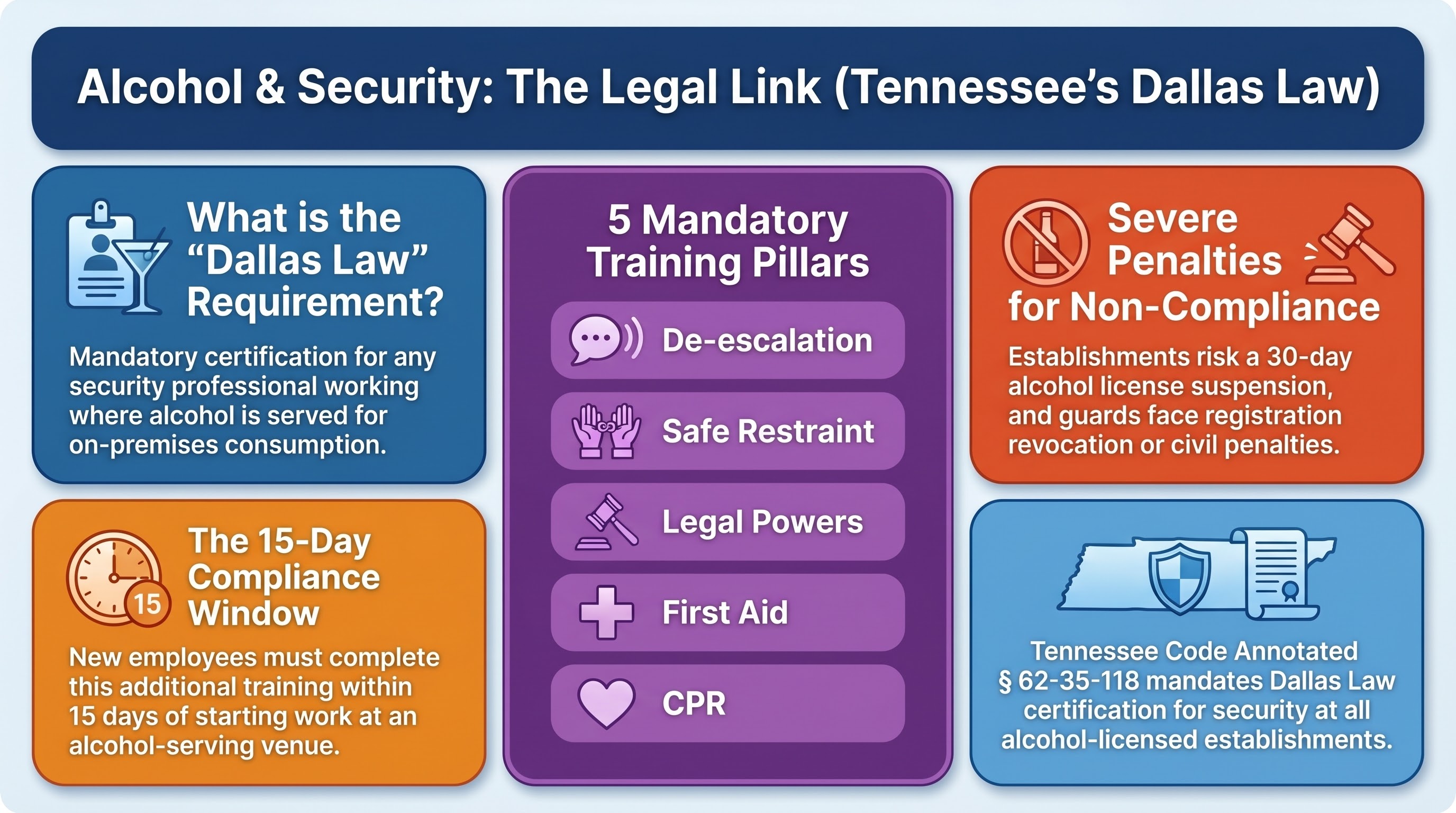
In Tennessee, if a business serves alcohol for on-premises consumption, the legal requirements for its security staff increase significantly. Under Dallas Law, security professionals working in these environments—whether they are contract guards or proprietary employees—must hold specific state certifications.
While 2026 legislation created "enhanced armed guard" designations for high-threat areas, the mandate for the hospitality sector remains strictly focused on conflict resolution rather than force. The curriculum requires:
De-escalation techniques to defuse volatile situations verbally.
Safe restraint methods to protect both the patron and the guard.
Legal powers and limitations of security guards and officers.
First aid and CPR training for immediate emergency response.
This represents a major shift in public safety strategy, moving from "muscle" to "medical and mental" preparedness. The Tennessee Alcoholic Beverage Commission (TABC) and local beer boards actively enforce this, possessing the authority to suspend a venue’s alcohol license for 30 days if untrained guards are discovered on the floor.
2. There is No Such Thing as an "Unregistered" Door Person
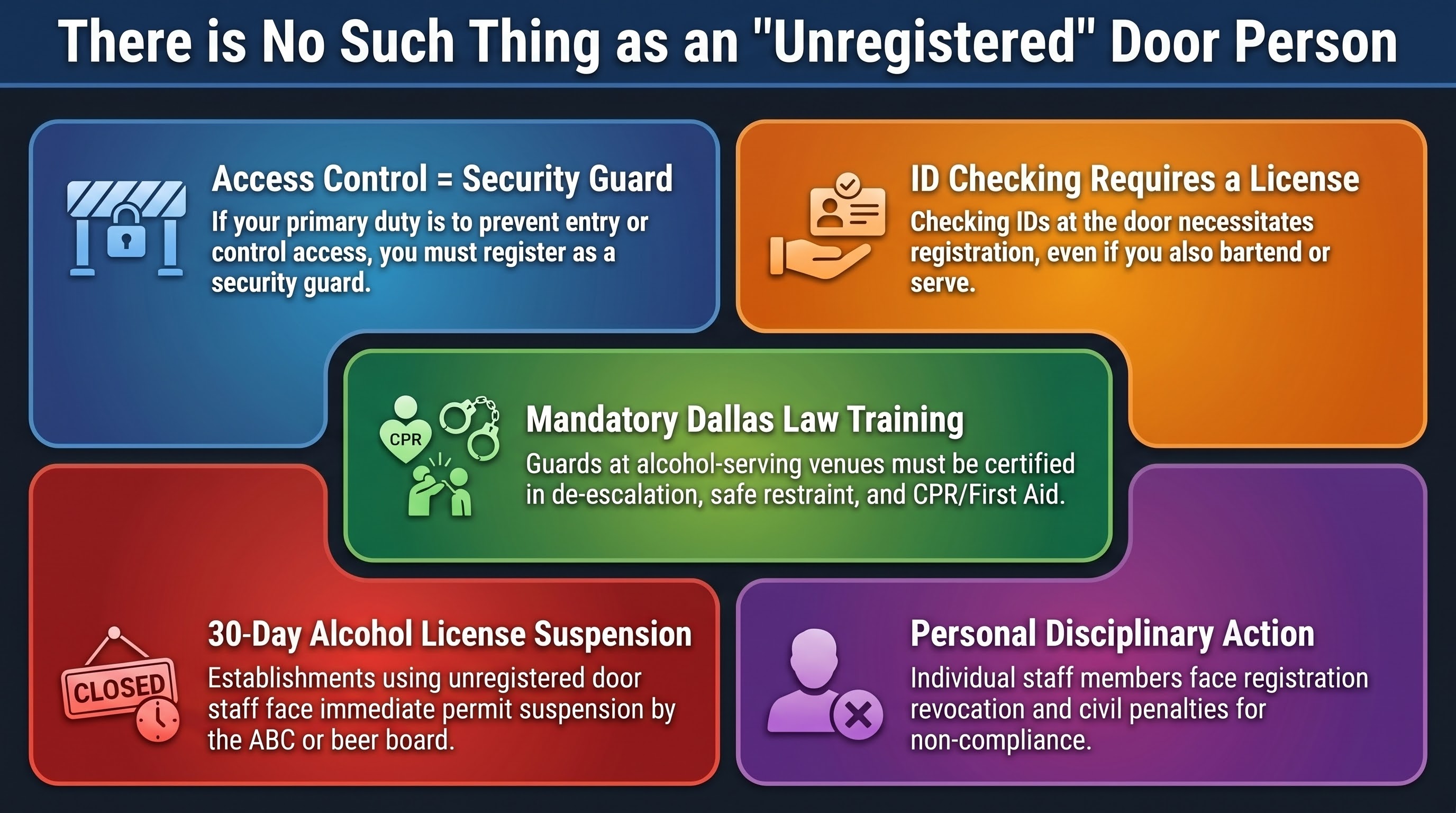
A common and costly "temporary help" trap exists for many establishments. Venue owners often assume that someone helping "just for the weekend" or a bartender pulling double duty at the entrance doesn't need formal registration. This is a legal fallacy.
If a person’s primary duty is to prevent entry, regulate the flow of the public, or check IDs at the door, they are legally classified as a security guard.
2026 Compliance Facts:
1 - There are no temporary worker exemptions.
2 - New 2026 legislative updates (such as SB1864) have expanded background check scrutiny, explicitly adding offenses like stalking to the list of strict disqualifiers, alongside theft, assault, and firearm offenses. Applicants with these records must wait at least 5 years post-sentence before even applying.
3 - Performing guard duties without professional registration is a Class A misdemeanor that can result in immediate facility closure and heavy fines.
3. The 75-Business-Day Grace Period Paradox
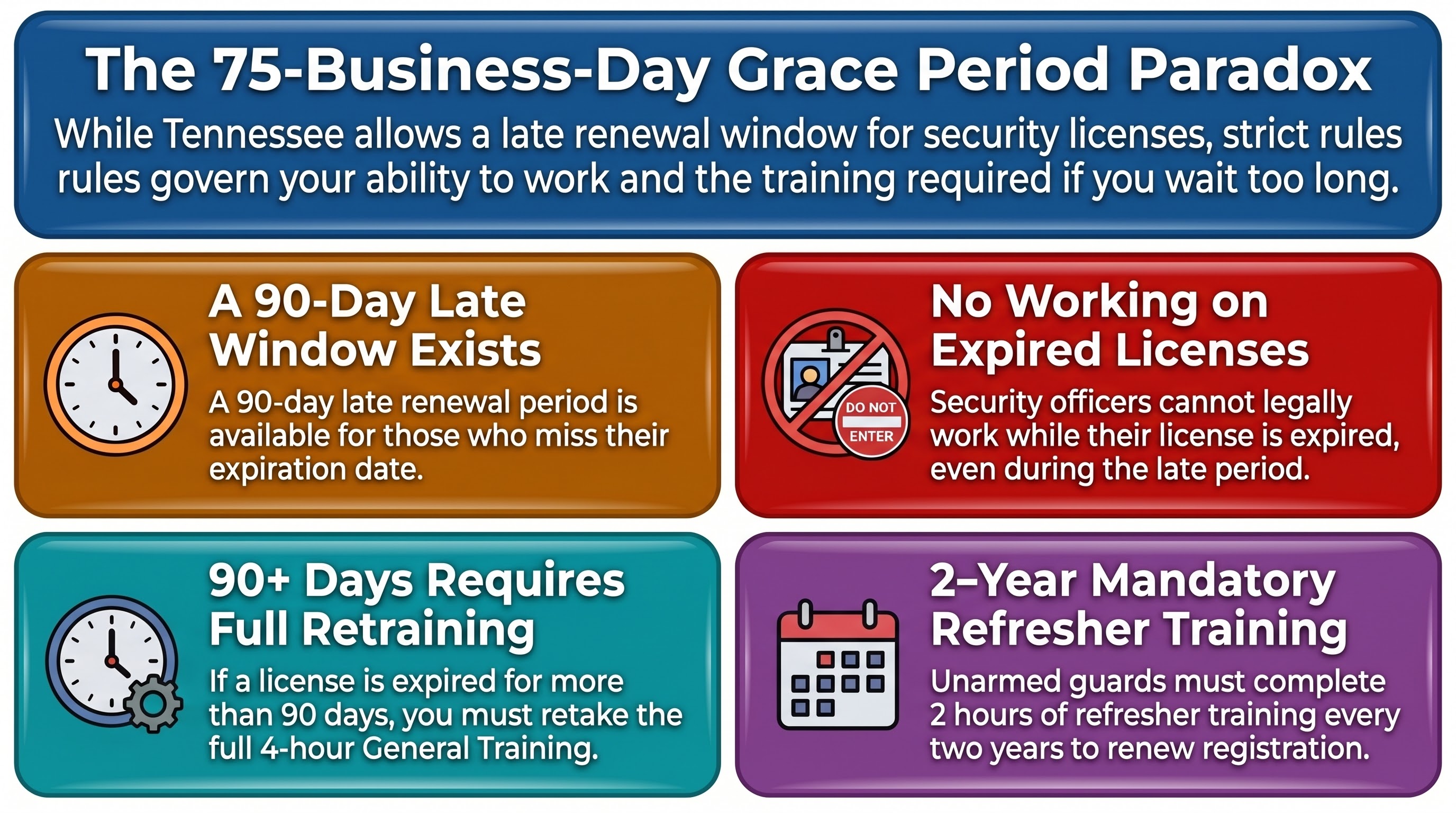
To address the soaring demand for personnel, Tennessee law allows a counterintuitive "grace period." Unarmed applicants may begin working for up to 75 business days while their official application is pending with the state.
However, in 2026, this has become a technical minefield for venue owners:
The Catch: While the state allows you to work pending licensure, Dallas Law still dictates that you must complete your First Aid, CPR, and De-escalation training within 15 days of employment if you work in an alcohol-serving venue.
The Requirement: To utilize this grace period legally, the guard must carry a copy of their completed application, proof of electronic fingerprinting, and specific identifying photos on their person at all times. If the application is ultimately denied, the individual must immediately cease and desist all security activities.
4. The Refresher Mandate is Now Heavily Audited
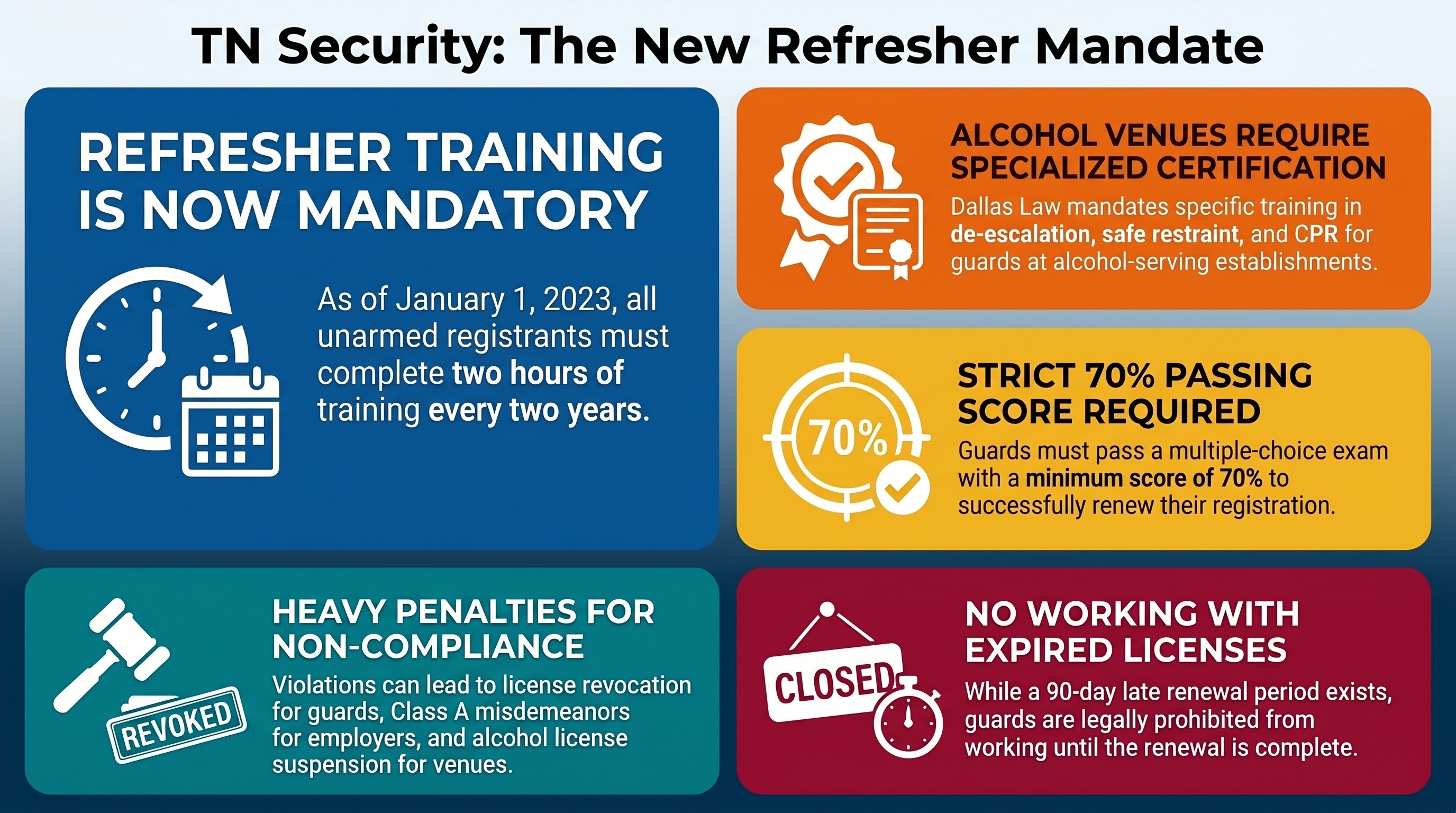
One of the most significant shifts for industry veterans was the end of the "one-and-done" license in 2023. Now, in 2026, this continuous professionalization model is heavily audited by the Department of Commerce & Insurance.
Standard Unarmed Guards: Required to complete 2 hours of refresher training every two years to renew their registration.
Dallas Law Certified Guards (Bouncers): Required to complete 2 hours of refresher training plus comprehensive 4 hours of Dallas Law training every two-year cycle.
This ensures that essential perishable skills—specifically safe restraint, first aid, and de-escalation—do not "rust" over time, maintaining a high standard of safety across the state’s bustling entertainment districts.
5. Your Smartphone is Now a Training Academy
The barrier to entry for professional training has been completely lowered by digital accessibility. Training no longer requires taking multiple days off work to sit in a physical classroom, a hurdle that previously kept many qualified individuals out of the profession.
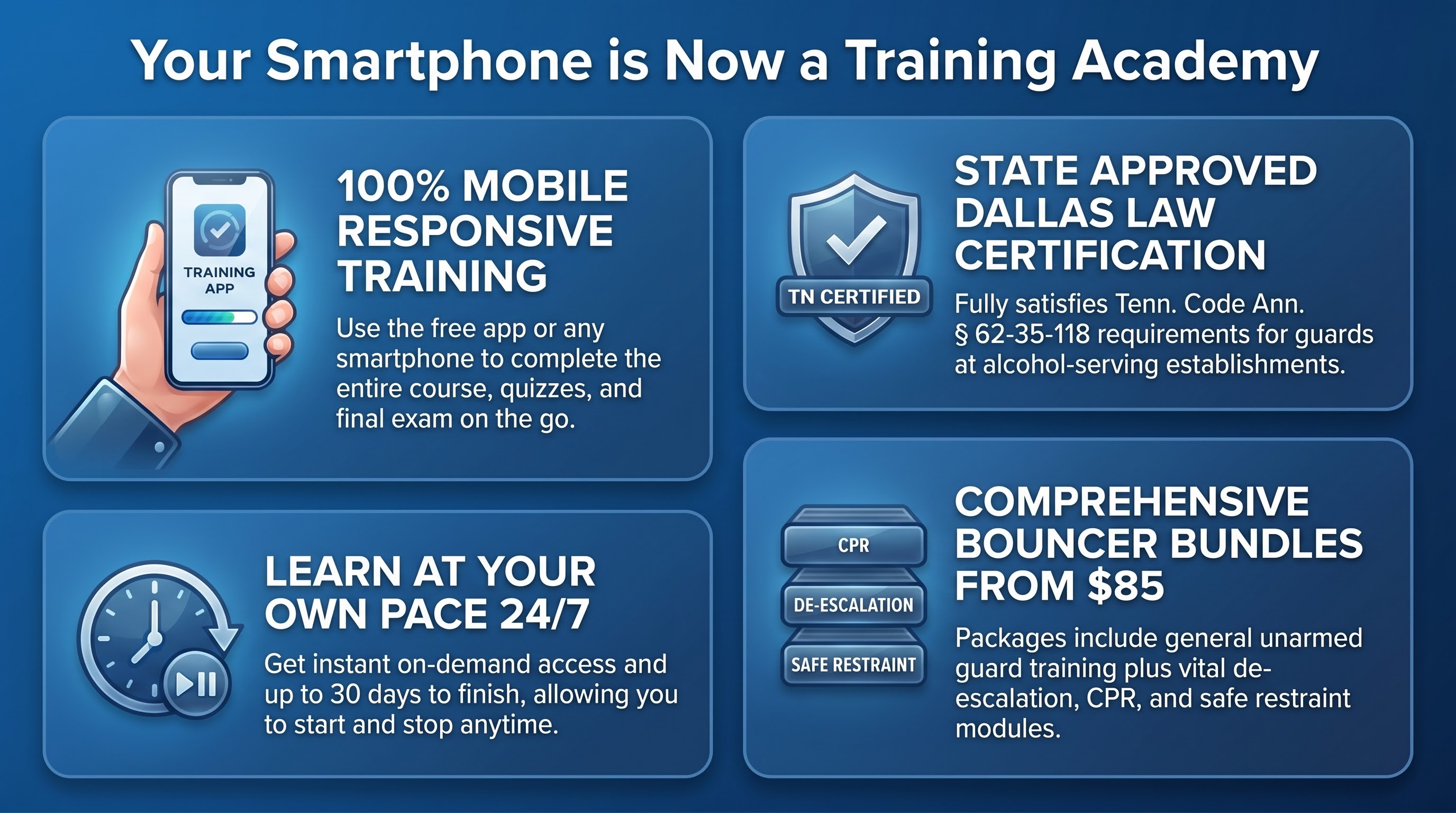
Alliance Training and Testing provides the Tennessee Bouncer Bundle, which includes both the standard Unarmed (Initial or Renewal) Training and the Dallas Law segment (which lacks a shortened regulatory version or modified alternative),via a 100% online, mobile-responsive platform approved by the state.
The Digital Learning Advantage:
Train anywhere: Complete modules between shifts or at home using a free app.
Micro-learning: The "10 minutes a day" concept fits perfectly into busy schedules.
Flexible timeline: Students have a generous 30-day window to complete the required coursework at their own pace, entirely eliminating the logistical barriers for a nightlife workforce that juggles non-traditional hours.
Conclusion: The Future of Tennessee's Front Line
The era of the "bouncer" stereotype is over, replaced by the "certified security professional." As Nashville, Memphis, and other Tennessee hubs continue to expand into global entertainment destinations in 2026, demand for highly trained, legally compliant responders is intensifying.
In an industry where a split-second decision can change a life and a single compliance error can permanently close a business, there is no room for "good enough." Ensure your team is compliant, fully registered, and digitally trained to meet the standards that Tennessee law—and your community—demands today.
📺 Watch: Complete 2026 Training Overview
Want to get fully compliant right now? Watch the overview of the 2026 Tennessee Bouncer Bundles below:
2026 Tennessee Bouncer License Requirements Dallas Law Compliance & Training Bundle
Key Video Takeaways:
[00:46] - New applicants can grab the initial bouncer bundle for just $110.
[00:55] - Those renewing can get the bouncer renewal bundle for $85 (for licenses expired under 90 days).
[02:22] - Be aware of strict disqualifying offenses, including felony firearm offenses, shoplifting, assault and battery, and controlled substance offenses.

Article by Angel Rodriguez CPP
Published 16 May 2026