Tennessee Private Protective Services Rules Updated: What Changed Effective June 15, 2026 (And What You Need to Do Now)
By Angel Rodriguez, CPP
Owner, Alliance Training & Testing LLC
The temporary emergency rules governing parts of Tennessee’s Private Protective Services program have officially ended, and the updated permanent rules took effect on June 15, 2026. If you are a security guard, armed officer, certified trainer, training provider, or security company owner, these changes directly impact your training requirements, weapon classifications, registration fees, and day-to-day compliance operations. Because these rules are newly active, many individuals and companies across the state are still unknowingly operating under outdated information.
As we navigate these changes, it is critical to ground ourselves in the actual regulatory reality of our state and the broader private security industry. Historically, rifles and similar long guns were never authorized for private security guards in Tennessee. Nationwide, allowing armed security officers to deploy rifles places Tennessee in a very small minority. Across the United States, the industry standard restricts armed guards to handguns or shotguns. States that do permit rifles typically reserve them for highly specialized assignments (such as armored transport in California) or restrict them entirely to honorably retired law enforcement officers (as in Texas). Tennessee did, however, maintain an independent shotgun qualification course that allowed armed guards to carry shotguns on post with the proper training. Under the June 15, 2026 updates, that legacy shotgun program has been completely absorbed and eliminated. Shotguns have now been moved into the strict, newly created "Enhanced" classification alongside rifles, fundamentally rewriting long gun compliance in Tennessee.
At Alliance Training & Testing, we have made a deliberate operational decision not to offer the new 16-hour Enhanced Armed Guard Rifle Certification. By making this decision, we choose to remain in strict compliance with the national industry standard. The immense civil liability, complex engagement protocols, and severe ballistic over-penetration risks associated with deploying high-velocity rifles in public or commercial environments are simply too great. Instead, our academy remains strictly focused on what we do best: providing the highest-caliber, safest training for standard unarmed registrations, armed handgun registrations, Dallas Law requirements, and authorized less-lethal weapons.
Below is the definitive, compliance-ready breakdown of exactly what changed under the updated Chapter 0780-05-02 rules, why it matters, and the practical steps you must take immediately to protect your credentials and remain fully compliant.
Quick Background: From Emergency Rules to Permanent Rules
What happened to the temporary Tennessee security rules? In late December 2025, the Tennessee Department of Commerce and Insurance filed emergency rules for Chapter 0780-05-02 (Private Protective Services) to address immediate operational changes resulting from recent legislative changes. On March 17, 2026, the permanent regulatory framework was formally filed. Following the mandatory review and waiting periods, these permanent rules officially became law on June 15, 2026, under the authority of the Private Protective Services Licensing and Regulatory Act (Tennessee Code Annotated, Title 62, Chapter 35).
Key Changes in the June 15, 2026 Rules
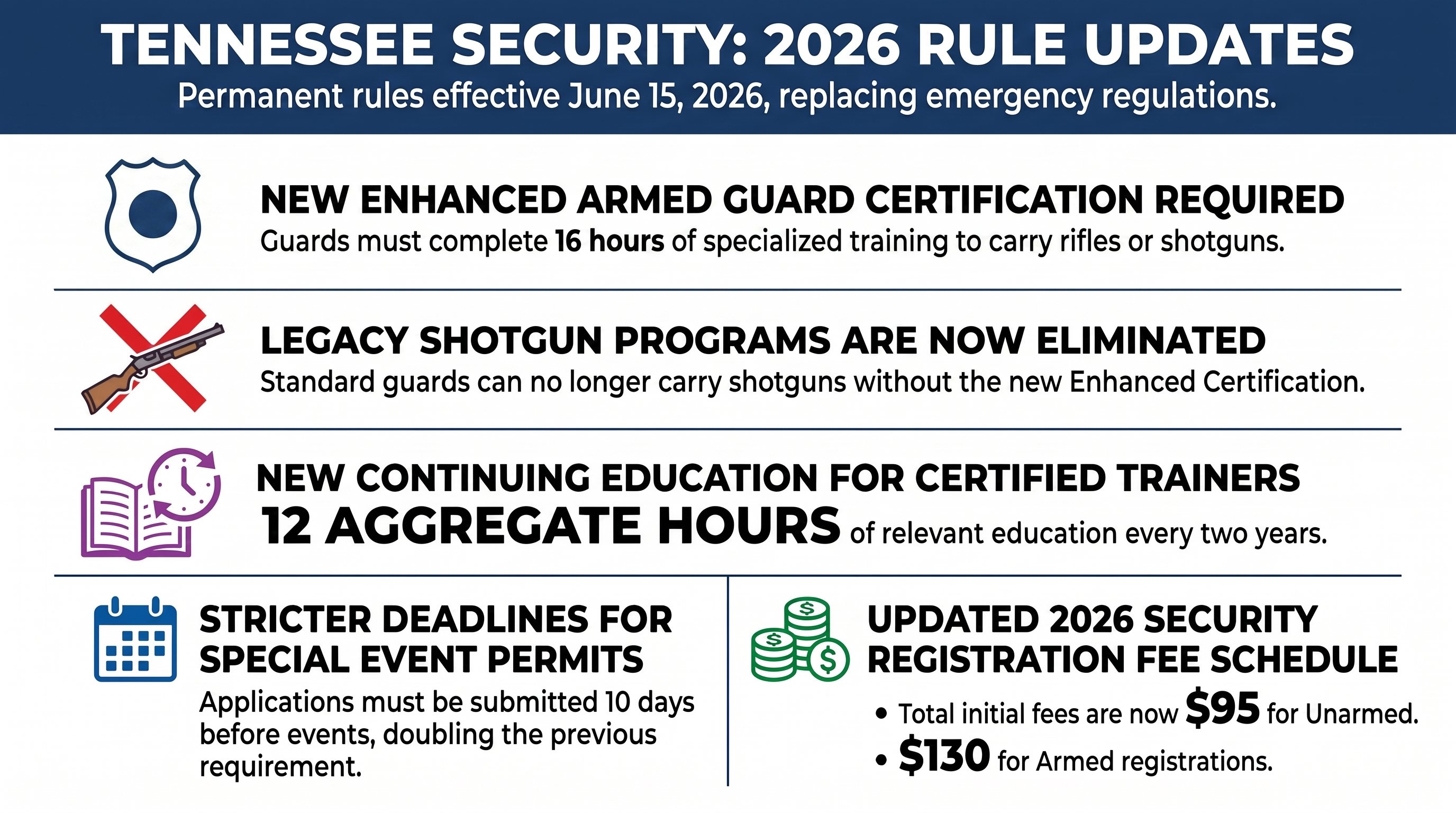
1. The Creation of "Enhanced Armed Guards" (§ 0780-05-02-.22)
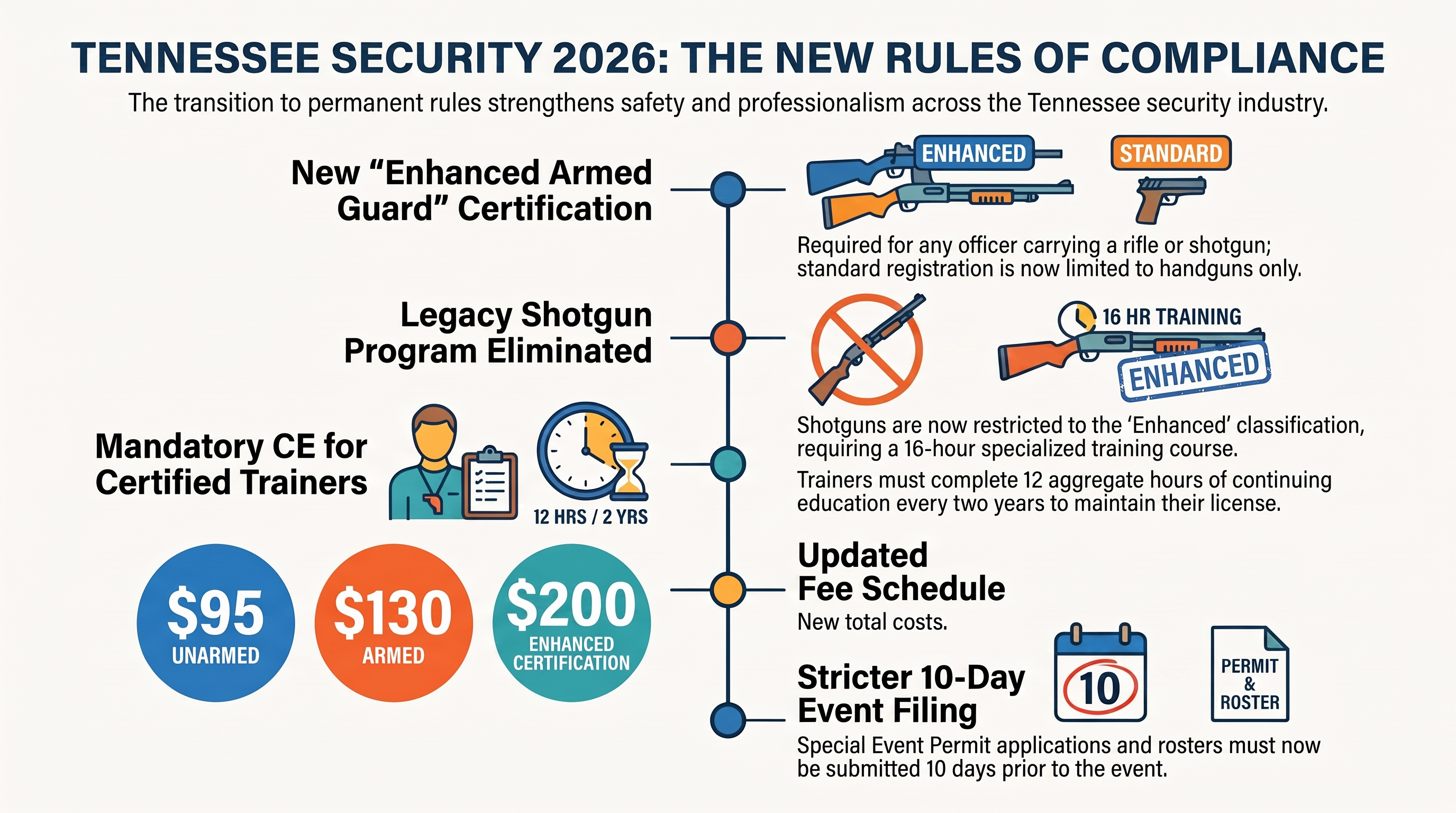
What is the Tennessee Enhanced Armed Guard Certification? The Enhanced Armed Guard Certification is a brand-new state credential required for any armed security officer who wishes to carry a rifle or a shotgun while on duty. A standard armed registration card remains strictly limited to approved handguns and pistols.
Absorption of the Legacy Shotgun Program: Pursuant to Public Chapter 344, the state's traditional shotgun qualification program has been dissolved. Standard armed security guards/officers can no longer carry a shotgun on post using their basic registration. Any guard who previously relied on the standalone shotgun qualification must now either qualify with an approved handgun caliber to continue working as a standard guard, or complete the full Enhanced certification.
Approved Long Guns: Enhanced Armed Guards are strictly restricted to a standard, pump-action 12-gauge shotgun with a fixed stock (tactical shotguns with modified or folding stocks are prohibited) and/or a standard .223 Rem or 5.56 NATO bolt-action or semi-automatic rifle. No pistol caliber carbines (PCCs) or short-barrel rifles are permitted unless explicitly approved.
16-Hour Training Mandate: Obtaining this certification requires a minimum of 16 hours of specialized training, including scenario-based deployment drills, safe long-gun storage training, and a 25-question written exam with a score of at least 75%.
Strict Live-Fire Qualification:
Rifle Course: Firing at least 90 rounds of live ammunition across distances of 7, 15, 25, and 50 yards, scoring at least 70% accuracy on approved IPSC/USPSA paper silhouettes.
Shotgun Course: Firing at least 20 rounds of live ammunition (including both buckshot and slugs) at 7, 12, and 20 yards, with a minimum accuracy of 70%.
Fees and Expiration: The application and renewal fee to add an Enhanced Certification is $200.00, and the certification must be renewed annually (unlike standard guard registrations, which run on two-year cycles).
2. New Continuing Education Requirement for Certified Trainers (§ 0780-05-02-.26)
What are the continuing education requirements for Tennessee security trainers? Under the new rules, certified trainers must complete 12 aggregate hours of relevant private security continuing education (CE) every two years as a strict condition of certificate renewal.
Acceptable Courses: Approved CE includes instructor-level security topics, emergency response training hosted by law enforcement or government entities, and post-secondary courses covering criminal justice or first-responder duties.
No Roll-Over Hours: All hours must be completed within the two-year window prior to expiration, and hours do not roll over to subsequent renewal cycles. Missing these hours can result in denial of renewal or administrative civil penalties.
3. Higher Experience Standards & Online Limits for Trainers (§ 0780-05-02-.11)
What are the new rules for Tennessee certified security trainers? The state has implemented stricter experience requirements for new trainers and placed hard limits on how security training courses can be distributed online.
The 5-Year Rule: Beyond the base 1-year supervisory mandate, new trainer applicants must document at least 5 years of full-time, compensated operational experience or instructional history within the security, law enforcement, or military sectors.
Enhanced Instructor Status: To teach the new 16-hour Enhanced Armed Guard course, trainers must submit their custom curriculum, class materials, and exam protocols to the Commissioner for review and pay a $100.00 classification fee.
Online Training Restrictions & Pioneering Standards: No trainer may conduct online classes for security guards unless the platform and specific course have been independently reviewed and approved by the Commissioner. Trainers must explicitly submit details on student authenticity verification methods and grant the state full access to audit the digital material. As the undisputed pioneer that launched the first state-approved online security training program in Tennessee's history, Alliance Training & Testing has long set the gold standard for digital compliance. Because our proprietary systems were built from the ground up to feature industry-leading student authentication and secure proctoring, our platform naturally meets and exceeds these rigorous new state auditing requirements, ensuring our students receive a seamless, fully compliant digital learning experience.
4. Hard Deadlines for Application Deficiencies (§ 0780-05-02-.08)
What happens if a Tennessee security guard application is incomplete? If an application is submitted with missing information or training documentation, the Commissioner will provide a hard deadline for remediation. If missed, the application will be closed or denied.
Re-opening Windows: Closed applications can only be re-opened without paying a double fee if missing court documents are provided within 30 days of closure, or if general missing application items are provided within 10 days of closure.
5. Revised Rules for Special Event Permits (§ 0780-05-02-.25)
What are the new requirements for Tennessee security Special Event Permits? Contract security companies relying on temporary permits for large-scale public events must submit applications at least 10 days prior to the event and include detailed guard registration tracking.
10-Day Filing Rule: Applications and temporary officer rosters must now be submitted to the state at least 10 days before the start of the event, doubling the previous 5-day requirement.
Roster Disclosures: The submitted roster must explicitly list the names and state registration numbers of all actively registered Tennessee guards working the event, alongside the law enforcement affiliations of any exempt officers being utilized.
Updated Fee Schedule Summary (§ 0780-05-02-.23)
How much does a Tennessee security guard license cost in 2026?
Be prepared for the modified fee landscape when submitting applications to the Department of Commerce and Insurance. The total upfront costs for registrations, certifications, and permits are structured as follows:
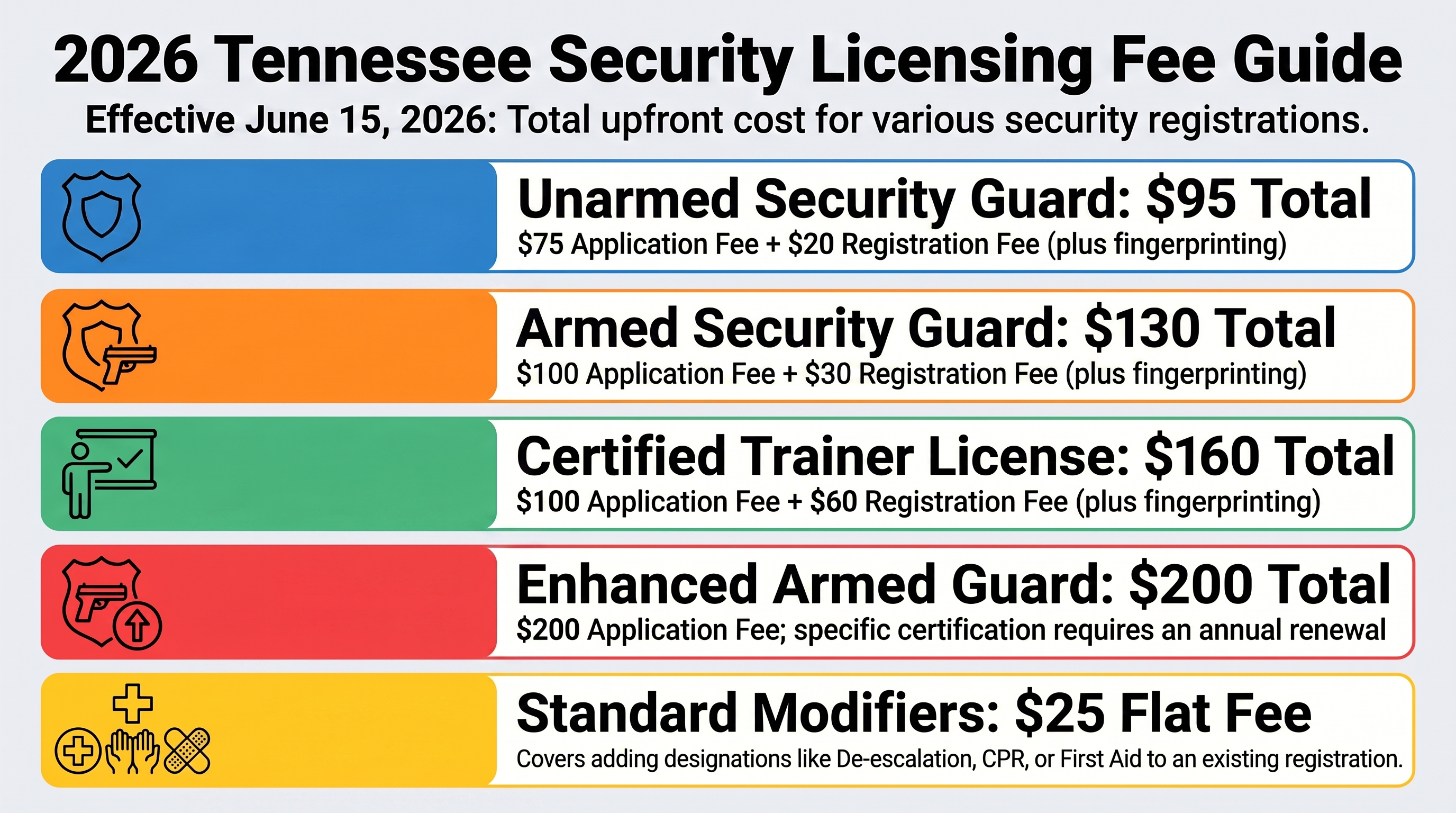
Unarmed Security Guard: $75.00 Application Fee + $20.00 Registration Fee = $95.00 Total (plus fingerprint processing fees).
Armed Security Guard: $100.00 Application Fee + $30.00 Registration Fee = $130.00 Total (plus fingerprint processing fees).
Certified Trainer License: $100.00 Application Fee + $60.00 Registration Fee = $160.00 Total (plus fingerprint processing fees).
Add Standard Modifier (De-escalation, CPR, First Aid, etc.): $25.00. Application Fee = $25.00. Total: $25.00 (Registration Fee: N/A).
Add Enhanced Armed Guard Certification: $200.00 Application Fee = $200.00 Total (Registration Fee: N/A; Must be renewed annually).
Add Enhanced Trainer Classification: $100.00 Application Fee = $100.00 Total (Registration Fee: N/A; Due again at certificate renewal).
Special Event Permit: $1,000.00 Permit Fee = $1,000.00 Total (Registration Fee: N/A; Per specific event).
Action Steps & Compliance Checklist
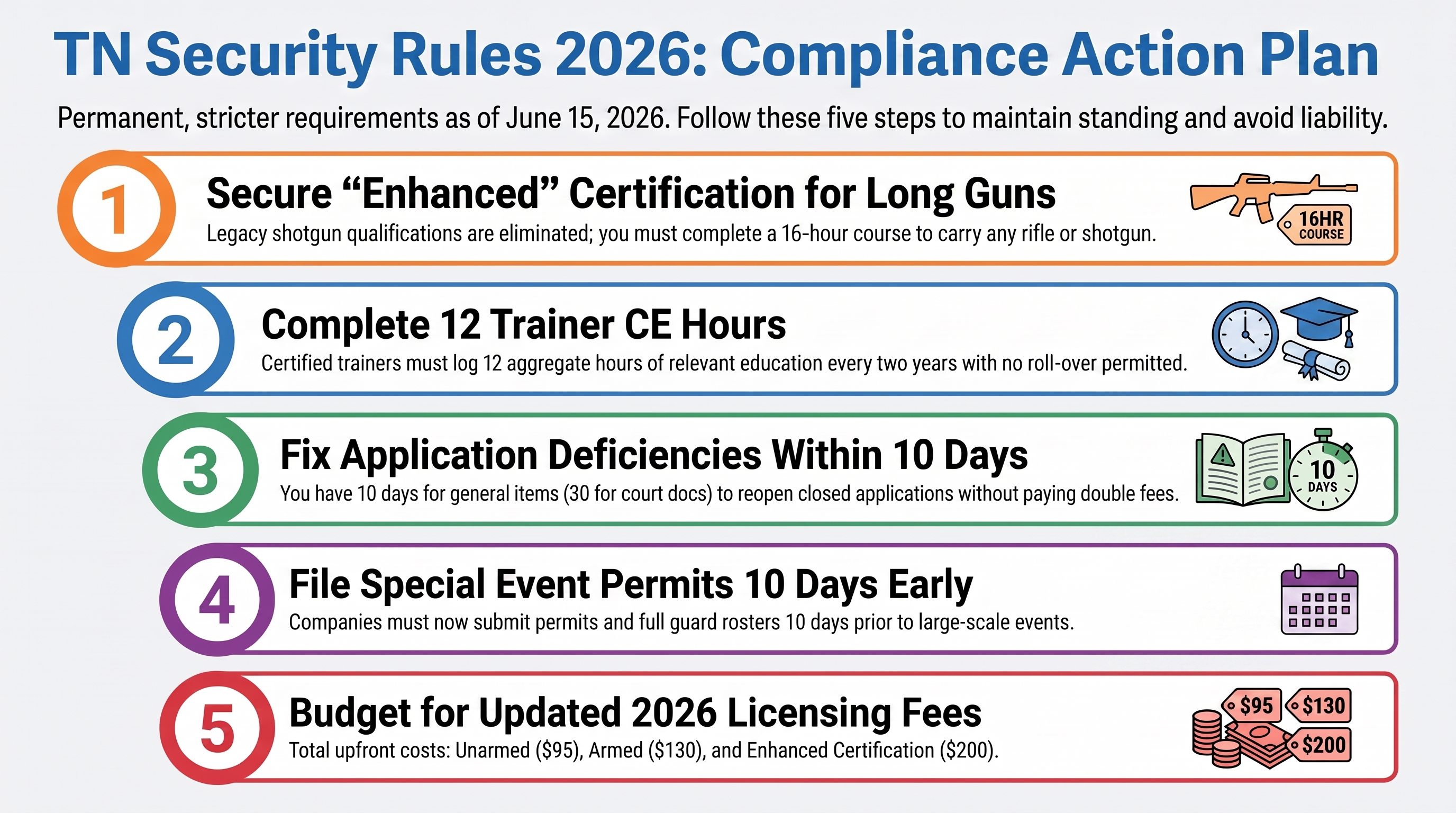
Check Your Long Gun Status: If your posts require shotguns or rifles, immediately schedule an approved 16-hour course with an authorized provider to secure your Enhanced Armed Guard certification. If you are currently a standard guard carrying a shotgun under a legacy qualification, you must step down from that weapon immediately to avoid compliance violations. (Note: Alliance Training & Testing does not provide the Enhanced Armed Guard certification).
Audit Your Roster (Owners): Ensure your guards have the necessary active designations on their physical cards before scheduling them at high-risk establishments, bars, or schools.
Track CE Hours (Trainers): Log your continuing education hours rigorously. Ensure you hit your 12 hours prior to your biannual expiration date, as hours will not roll over.
Adopt the 10-Day Rule for Events: Adjust your administrative calendars so that all Special Event Permit applications clear the state desk a minimum of 10 days out.
Frequently Asked Questions
Can a standard armed guard carry a shotgun if they passed the old shotgun qualification?
No. The legacy shotgun qualification program has been entirely eliminated and absorbed into the new law. As of June 15, 2026, shotguns are completely restricted to guards holding the Enhanced Armed Guard Certification. Standard armed guards are restricted to approved handguns and pistols.
Were rifles previously allowed for private security in Tennessee?
No. Prior to this legislative update, rifles were never authorized for private security guards in Tennessee. Allowing rifles places Tennessee among a very small minority of states nationwide that offer long-gun certifications to private security officers.
How long does the Enhanced Armed Guard certification last?
The Enhanced Armed Guard certification is valid for exactly one year from the date of issuance. It requires annual live-fire requalification on an approved course of fire and a $200 renewal fee.
Does Alliance Training & Testing offer the 16-hour Enhanced Armed Guard course? No. As outlined at the beginning of this article, we have made a deliberate operational decision not to offer the Enhanced Armed Guard Rifle Certification to remain aligned with the national industry standard. The immense civil liability, complex engagement protocols, and severe ballistic over-penetration risks associated with deploying high-velocity long guns in public or commercial environments are simply too great. Instead, our academy remains strictly focused on what we do best: providing the highest-caliber training for standard armed, unarmed, Dallas Law, and authorized less-lethal tool certifications.
What happens if my guard application is closed due to missing documents?
You have a strict 10-day window (30 days if the item is a court document) to submit the missing pieces to reopen the file without repaying your application fees.
Where can I verify the exact text of the new laws?
The full text can be verified directly via the Tennessee Secretary of State Division of Publications under Rulemaking Hearing File Sequence Number 03-15-26.
Final Thoughts
The transition to permanent rules effective June 15, 2026, strengthens consistency, safety, and professionalism across Tennessee. While absorbing the legacy shotgun program into the new 16-hour Enhanced long gun certification adds administrative steps, it ensures that security personnel deploying high-powered weapons on post are comprehensively trained and vetted.
As we discussed in our detailed breakdown, Why Alliance Training & Testing Will Not Offer the Tennessee Enhanced Armed Guard Rifle Certification, the immense liability and public safety risks associated with bringing high-velocity rifles into private security posts are why our academy has chosen not to provide this specific long-gun training.
However, staying compliant with the other new updates doesn't have to disrupt your business. If you need to renew your standard unarmed or armed guard registration, complete the required state training, or add vital certifications such as Dallas Law or less-lethal authorization, Alliance Training & Testing offers state-approved online and in-person courses tailored to meet the newly updated Tennessee requirements.
Need help keeping your team compliant with the latest DOI rules? Visit securityguardlicensetn.com to explore our current course offerings or contact our team directly.
We are here to keep Tennessee's security professionals educated, prepared, and operating on the right side of the law.

Article by Angel Rodriguez CPP
Published 12 Jul 2026