The New TN Security 10-Day Rules: The Hidden B2B Compliance Trap
BLUF (Bottom Line Up Front):
The 2026 Tennessee Department of Commerce and Insurance (TDCI) regulations enforce strict 10-day reporting windows for address changes, employee terminations for cause, and qualifying arrests/citations/convictions. For security companies, venue directors, and hospitality managers, failing to report a guard’s termination for cause (or a qualifying arrest) within 10 days is a major compliance trap that exposes your business to liability and potential disciplinary action.
Introduction
The ground is shifting beneath the feet of Tennessee’s security industry. With the 2026 TDCI rule updates, seemingly small administrative requirements are creating significant compliance traps for the unprepared.
While much of the industry’s attention has focused on the 15-day training windows for Dallas Law (alcohol-serving venues) and the enhanced armed guard requirements, the state maintains strict 10-day reporting clocks across multiple areas. This post breaks down what these 10-day mandates actually require, why they create real risk for employers, and how organizations can stay compliant in a high-turnover industry.
The 10-Day Reporting Rules (Arrests, Address Changes & Terminations)
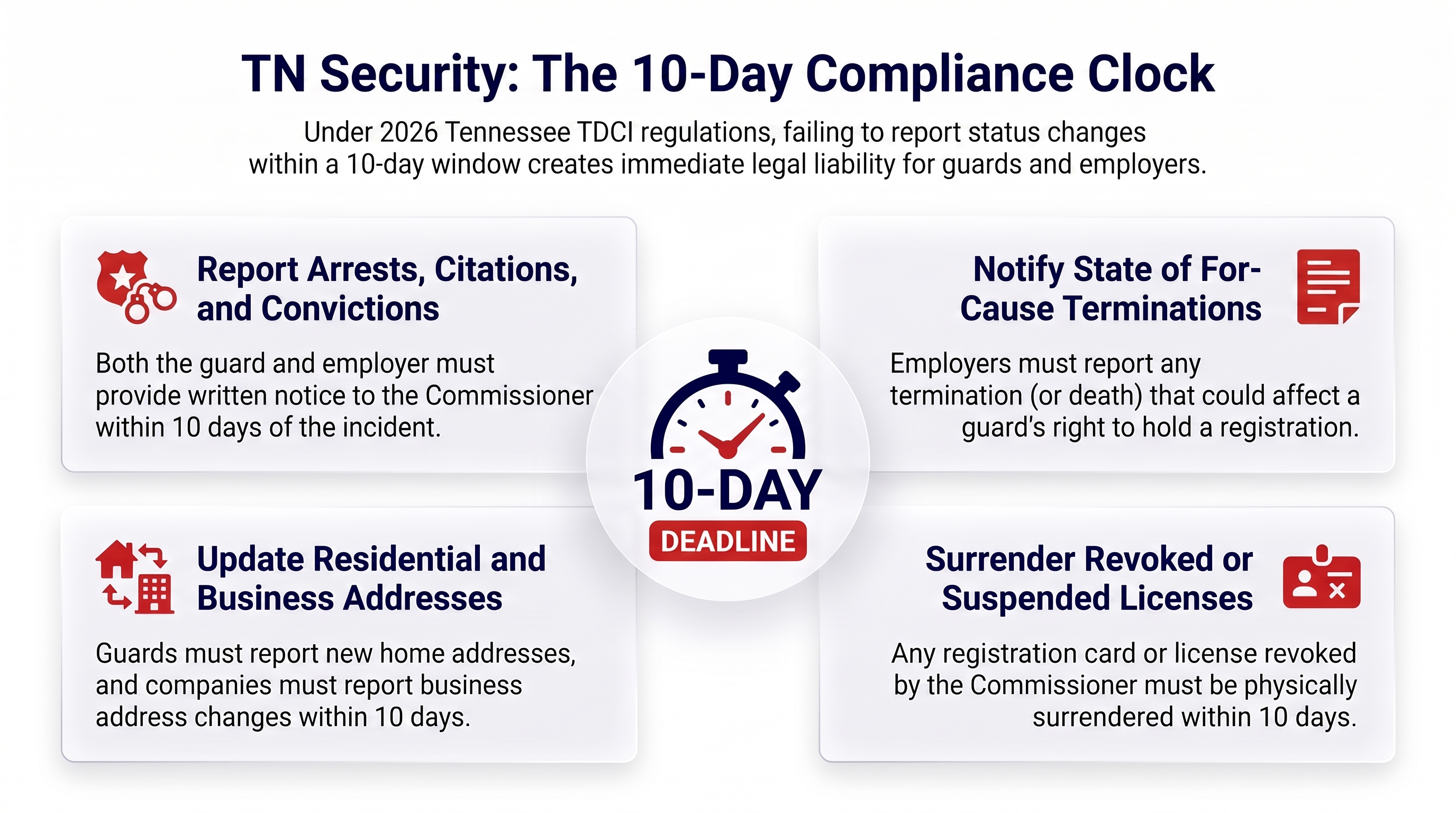
Tennessee law places parallel 10-day written notice duties on both the individual guard and the employer.
Arrests, Citations & Convictions
Under T.C.A. § 62-35-120, a security guard/officer must provide written notice to the Commissioner (or designee) and to the employing licensee or proprietary security organization (PSO) if the guard is subject to any arrest or citation for an offense listed in § 62-35-117. Notice must be given within ten (10) days of the arrest or citation (whichever occurs first) and must include a copy of the charging documents.
A separate 10-day written notice is required for any conviction of an offense listed in § 62-35-117. Armed security guards have additional 10-day reporting duties for any arrest, conviction, order of protection, bond condition, or other circumstance that affects their ability to carry a firearm.
Employers have parallel duties. Under T.C.A. § 62-35-124, a licensee or PSO must provide the same 10-day written notice to the Commissioner regarding arrests, citations, or convictions of any security guard they employ (as well as the licensee, qualifying agent, or manager).
(Note: Certified trainers have a separate 30-day window under Rule 0780-05-02-.11(1)(c) for incidents that affect their own ability to instruct. That clock does not apply to guards.)
Address Changes
Guard residential address changes: Any registered security guard must notify the Commissioner in writing within ten (10) days of a change in residential address (Rule 0780-05-02-.16(2)).
Business address changes: Licensees, certified trainers, and PSOs that have filed notice under § 62-35-123 must notify the Commissioner in writing within ten (10) days of any change of business address (Rule 0780-05-02-.16(1)).
The Employer Termination Rule
Rule 0780-05-02-.17 states:
A licensee or proprietary security organization shall notify the Commissioner in writing within ten (10) days of the death or termination of an employee/registrant for any occurrence which could reasonably be expected to affect the employee/registrant’s right to hold a certificate of registration under this chapter.
Why Rule.17 Is a Major B2B Compliance Trap
For hospitality managers, contract security companies, and venue directors, the Employer Termination Rule is a ticking clock.
Imagine this scenario: You terminate a guard because of an off-duty assault or because the individual arrived at work under the influence. You part ways and consider the matter closed. However, if the reason for termination reasonably affects the individual’s fitness to hold a registration card, you have 10 days to formally notify the state.
Failure to report creates exposure. If that individual later works at another venue and an incident occurs, your company can be investigated for failing to comply with state reporting mandates.
The Operational Reality: High Turnover & Staggered Cadence
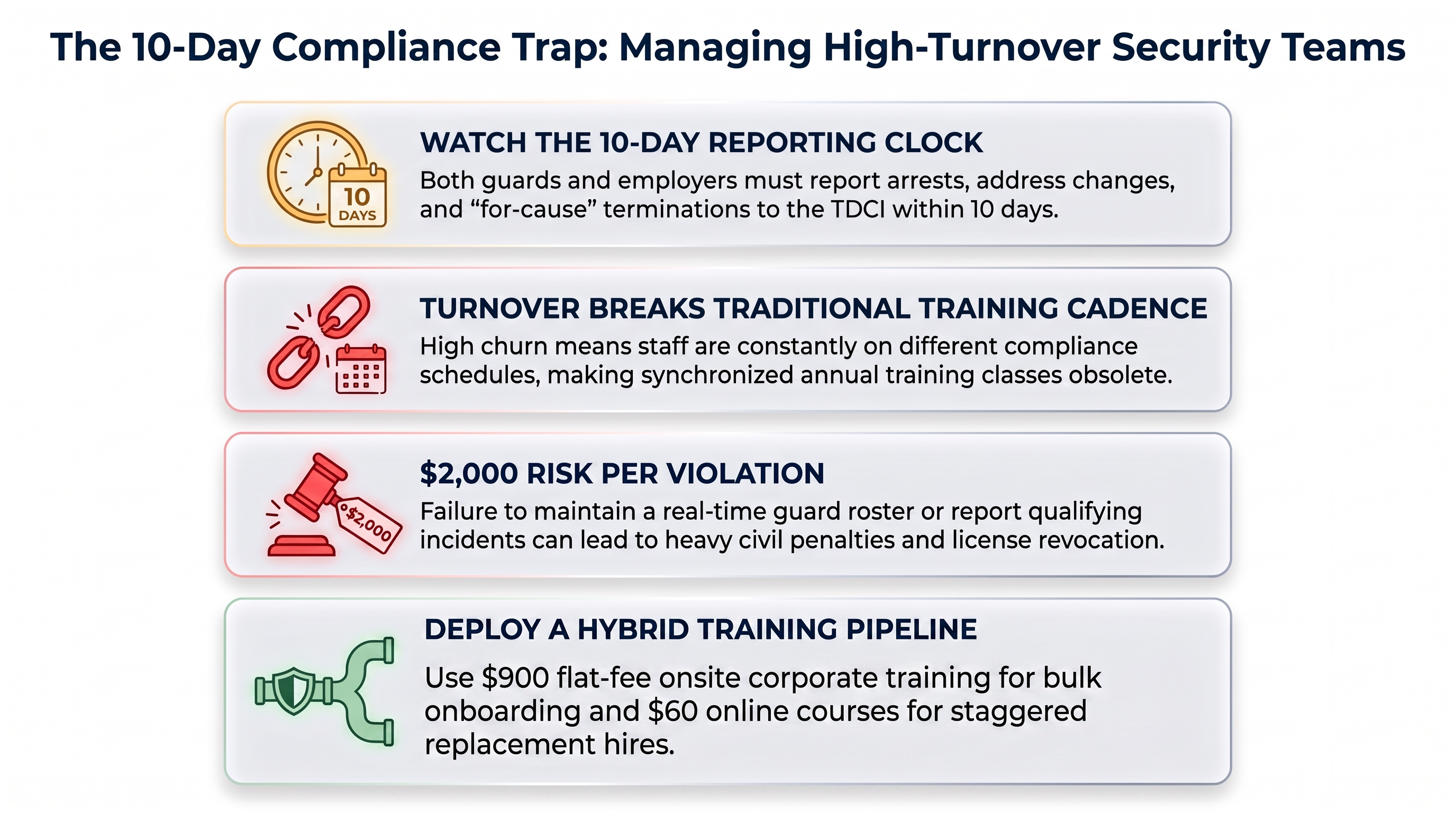
Here is the operational reality for B2B managers: You will never get everyone on the exact same training cadence.
You can train a crew of twenty guards one month, and by the next month half of them are gone. In the high-turnover security and hospitality industries, relying on a single, perfectly timed annual training class is unrealistic.
Because of this constant churn, tracking staggered 10-day reporting windows, fluctuating compliance statuses, and immediate offboarding notifications becomes a logistical challenge.
Key Questions for Leadership:
Do our HR offboarding policies include an immediate TDCI notification protocol for “for cause” terminations?
Are we maintaining a current, easily accessible guard roster? (Investigators can demand your roster at any time; failure to immediately provide a copy is a violation of T.C.A. § 62-35-130(a)(11) and Rule 0780-05-02-.18(3).)
How do we systematically train new replacements the moment a guard leaves?
A Step-by-Step Guide to Bulletproof Compliance
Update Employee Handbooks — Explicitly require guards to update their residential address with the state within 10 days of moving.
Overhaul Offboarding — Create a mandatory HR workflow. If a guard is terminated for violence, theft, substance issues, or any occurrence that could affect registration eligibility, notify the Commissioner within the 10-day window.
Audit Your Rosters — Maintain a real-time, easily accessible roster of all security personnel.
Standardize Your Training Pipeline — Build a system that handles both bulk seasonal hiring and immediate individual replacements.
The Strategic Solution: Alliance Training and Testing
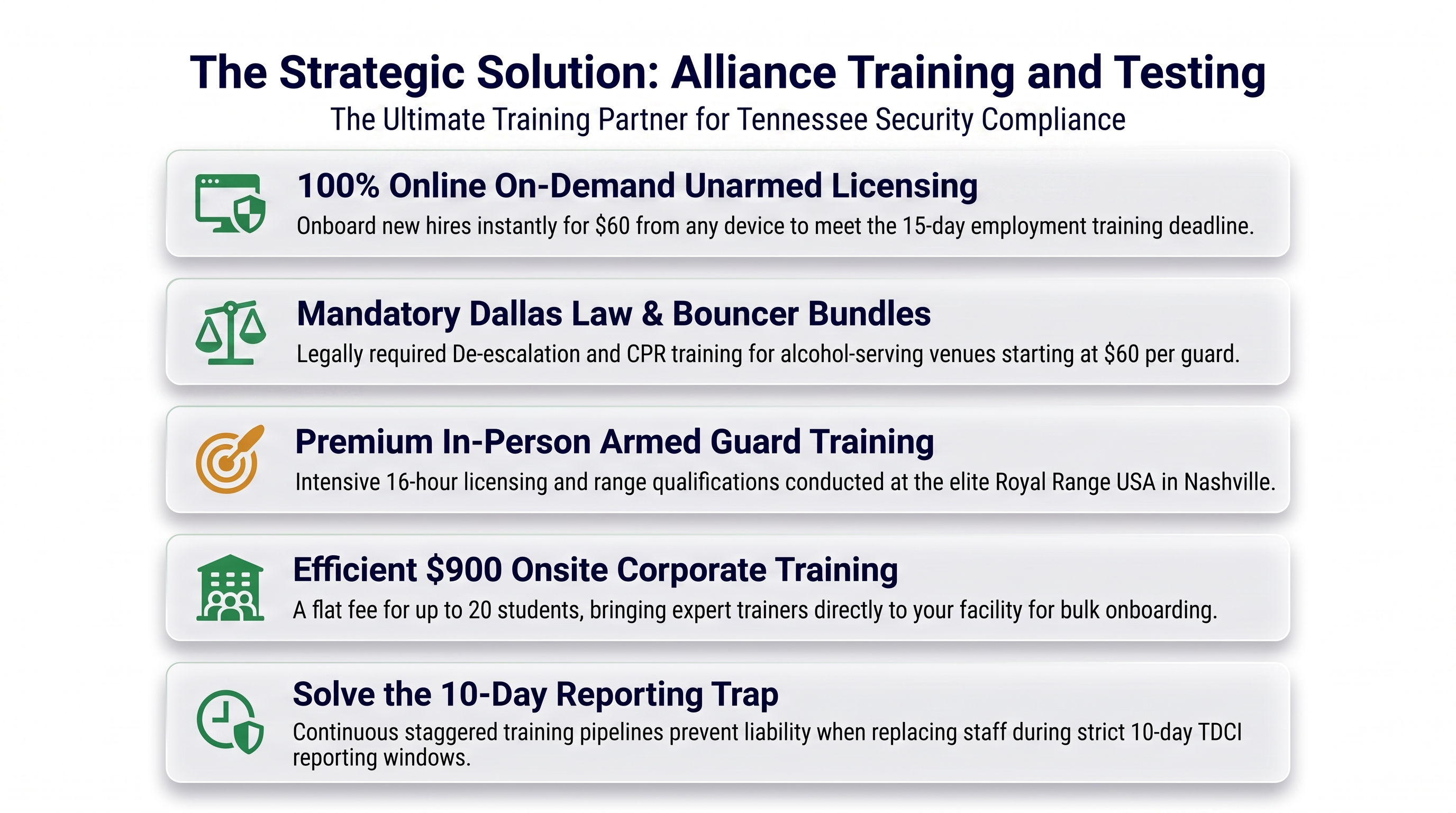
To operate effectively under these rules, you need a training partner designed for constant operational churn. Alliance Training and Testing provides solutions for both bulk onboarding and continuous staggered hiring:
1. For New Staff & Program Restarts
Onsite Corporate Guard Training ($900 Flat Fee) — Ideal when launching a new venue, restarting a program, or completing baseline onboarding. An expert trainer travels to your site for up to 20 students (+ $40 per additional student).
2. For Ongoing Turnover & Staggered Hires
100% Online Unarmed Guard License ($60)— Immediate replacements certified on demand.
Online Dallas Law Certification ($60) — Required First Aid, CPR, Safe Restraint, and De-Escalation training for alcohol-serving venues.
Unarmed Guard 2-Hour Renewal ($30) — Keep active staff compliant without pulling them off the floor.
Tennessee Bouncer Bundle ($110) — Combined Online Unarmed License + Dallas Law course.
Renew Tennessee Bouncer Bundle ($85) — Combined 2-Hour Unarmed Renewal + 4-Hour Dallas Law Renewal.
Conclusion: The Clock Is Ticking
The TDCI 10-day rules are more than administrative formalities — they create real employer liability. Swift, documented action is the only reliable path to compliance. Protect your business by updating reporting policies and securing a hybrid training pipeline that combines bulk flat-rate packages with flexible online options so your organization is never caught off guard by turnover.
Call to Action
Stop gambling with your venue’s compliance. Contact Alliance Training and Testing today to schedule an on-site corporate package or enroll staggered staff in our online training bundles. Keep your entire team fully compliant with the current 2026 TDCI requirements.

Article by Angel Rodriguez CPP
Published 24 Jul 2026